• Home
  • About
    • Governance & Structure
      • The AER Executive Board
      • The AER General Assembly
      • The AER Political Bureau
      • Statute & strategies
        • AER Election Committee
        • AER Monitoring & Evaluation Group (MEG)
        • AER Procedures
      • The AER Secretariat
    • The History of AER
  • Members
    • Who are AER’s members?
    • Member Directory
    • AER stands with Ukraine
    • Join AER!
  • Mutual Learning
    • About Mutual Learning
    • Working Groups
    • Knowledge Transfer Events
  • Advocacy
    • About Our Advocacy Work
    • The Bureau
    • The 2030 Agenda for Sustainable Development
    • AER Political Priorities 2025-2030
  • Projects
    • About Our Projects
    • Ongoing Projects
    • Look for Partners
    • Completed Projects
  • AER Programmes
    • AER Summer Academy
    • Eurodyssey – Paid traineeships in European regions
    • Intercultural Regions Network
    • AER Youth Regional Network (YRN)
  • Events
    • AER events
    • Other events

Assembly of European Regions

Connecting regions, inspiring Europe since 1985

You are here: Home / Search for "mental health"

Search Results for: mental health

Food in Focus at Spring Plenaries in Örebro

1 April, 2019 By Erica Lee

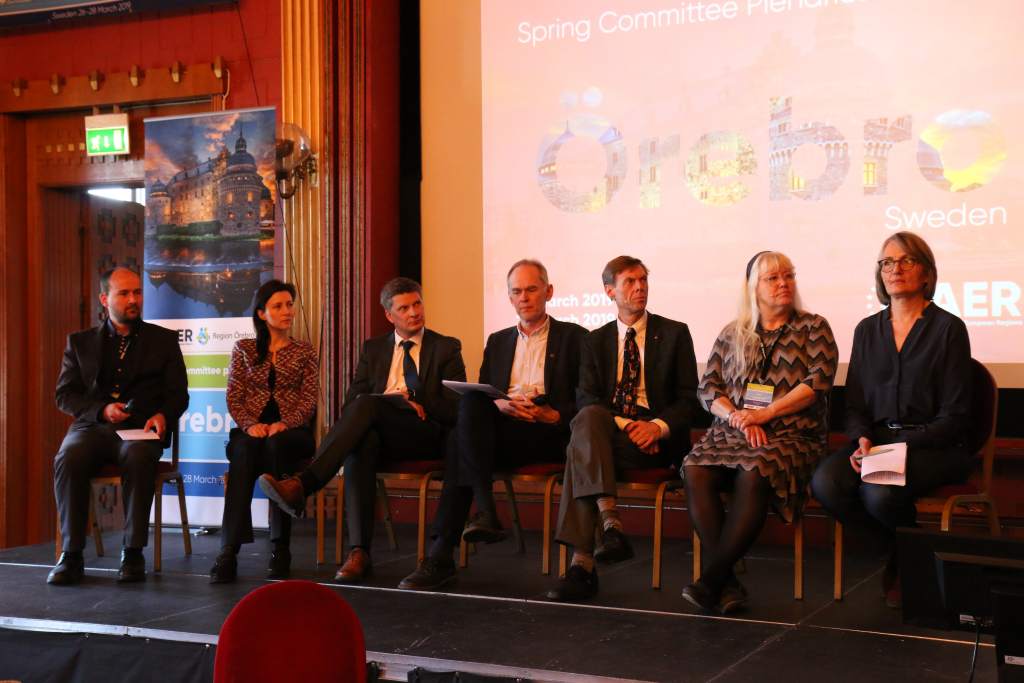
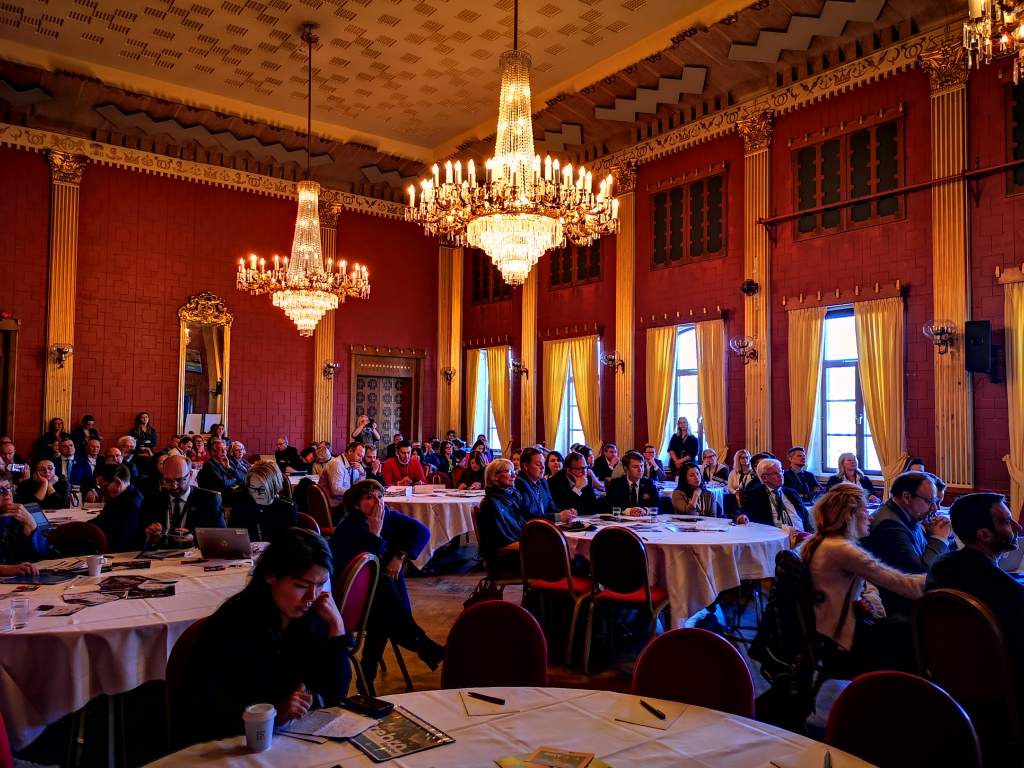
The AER Spring Committee Plenaries, which took place from 26-28 March 2019 in Örebro County, Sweden, revolved around food, innovation and health.

The seminar ‘Food for Action!’ A regional approach to innovating food systems, was an exemplary opportunity for regions to share how they innovate food systems to achieve nutrition for healthy and sustainable diets, climate and environmental sustainability, circularity and resource efficiency, and innovation and empowering communities.

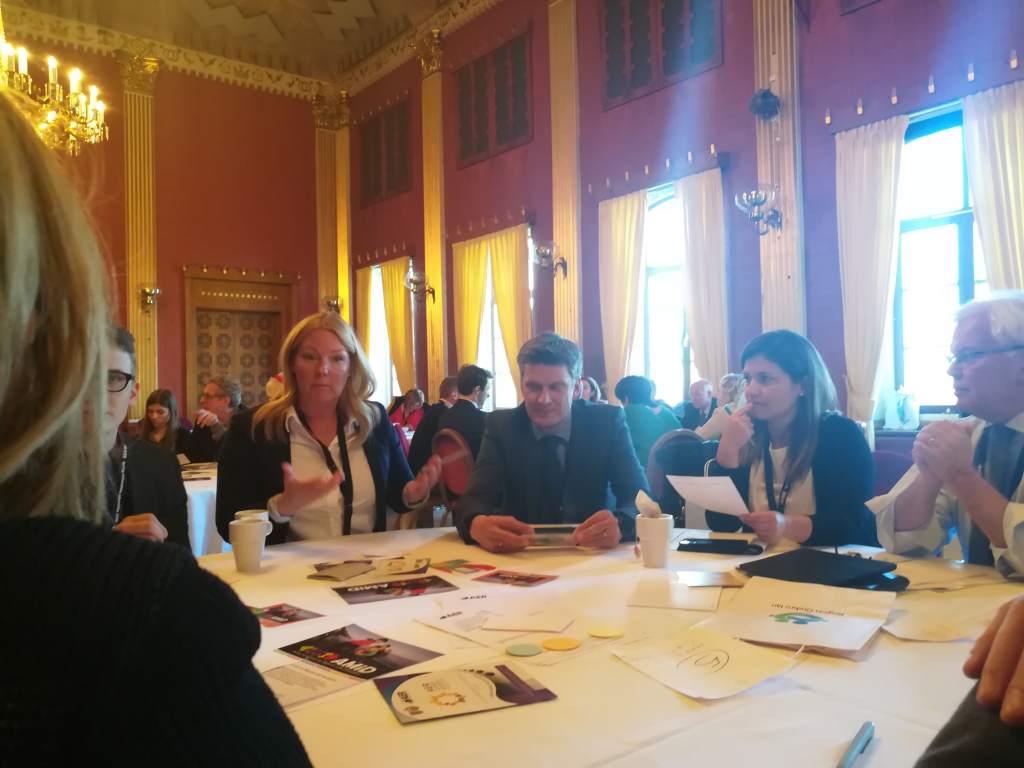
Moderated by Tina Wu, Member Relations Coordinator the seminar saw participants engage in a multisensory activity on Sensory research within the field of Gastronomy – a multisensory perspective in order to promote healthy eating” delivered by Åsa Öström, from Örebro. This delightful and delicious experience was followed by inputs on nutrition & mental health by Robert Jan Brummer, another expert from Örebro County. AER members Olimpia Neagoe, Dolj (RO), Peter Medved, Eastern Slovenia (SI), Erik Lagethon, Oppland (NO), Thomas Norrby, from the European Network for Rural Development (ENRD), were among the participants who then shared insights from their regions and networks on the all-encompassing issue of food, nutrition and innovation.

Keeping with the theme of food a Breakfast Debate was organised on youth entrepreneurship, and all participants to the Joint Plenary had the opportunity to join a dinner reception at Örebro Castle where they were greeted by Governor of Örebro, Maria Larsson and President of the Regional Executive Board Andreas Svahn, and treated to a vast menu of local specialities including Hjalmaren Pikeperch.

A number of other successful workshops that took place at the Plenaries included:

  • Energy and Climate Change: the SDGs as a policy framework
  • Transports & Mobility: Open Data & Blockchain
  • The AMID workshop on multilevel cooperation for migration policies
  • Available opportunities for AER members in current projects

As always, the three AER Committees

  • Economy and Regional Development
  • Social Policy and Public Health
  • Culture, Education and Youth

held their dedicated plenary sessions and outlined achievements made over the last six months and spent some quality time reflecting on the work programmes for the upcoming year. More on this to follow!

Follow AER!
Facebooktwitterlinkedinrss

Committee 2 Progress Report Spring 2019

8 March, 2019 By Editor

Twice a year the members of the AER Committee on Social Policy and Public Health gather in plenary meeting. This is the opportunity to set goals for cooperation through the elaboration of a joint work programme and to evaluate progress every six months.

On the occasion of the Spring 2018 Committees’ plenaries in Arad, AER members identified joint actions they wanted to implement with fellow regions. A year later it is time to evaluate progress, celebrate achievements and share experiences!

Evaluating progress

During the elaboration of the work programme in Arad, planned activities were organised in 3 categories:

Projects
Good practice sharing
Lobbying

The below progress report was compiled for the spring 2019 plenary meeting in Örebro. It gives an overview of the situation, 1 year after the adoption of the work programme.

Projects

SCIROCCO Exchange project – Personalised knowledge transfer and access to tailored evidence-based assets on integrated care: ongoing

The SCIROCCO Exchange project, under the 3rd Health Programme, is based on the SCIROCCO project, which has resulted in the development of an online self-assessment tool for integrated care. The project will run from end 2018 to end 2020. It will support regions, mainly health and social care authorities for the adoption and the scaling-up of integrated care. The maturity matrix, at the core of the project, offers a tool for regions to better deliver integrated care for their citizens while at the same time empowering citizens. With this tool regions can assess their current status, revealing areas of strengths and also gaps in their capability managing the many activities needed in order to deliver integrated care.

The lead partner is the Scottish Government Health Agency Service, a new AER member. The consortium is composed by 14 organisations.

AER is leading the Working Package on knowledge transfer, helping the regions in preparing the local environment for implementation and scaling-up integrated care.

Together for Cohesion: let’s rEUnite! project: ongoing

The project will launch an integrated campaign “Together for Cohesion: let’s rEUnite!” with ongoing press functions and an activity mix which will allow us to achieve indirect and direct reach of the target audience.
The campaign centers on the stories of locals in regions in each of the five selected countries (Croatia, Hungary, Romania, Italy and Spain), as a highly-relatable focal points to convey the positive impact of Cohesion policy in people’s everyday lives.

The project is led by AER with the international communication agency MC Group (DE). The application was submitted to the DG Regio on the media calls for proposals.

The project is part of AER’s work on Cohesion Policy.

AMiD project for the inclusion of migrants with disabilities: ongoing

This project is led by the European Association of Service Providers  for Persons with Disabilities and aims to improve the access to services for migrants with disabilities. AER is a partner and Valencia, Timis and Värmland are all members of the Advisory Board. The AMiD project will provide opportunities for experience sharing and capacity building in this area for all AER members.

Silver Economy Awards (SEED): finished

The Silver Economy Awards aim to catalyse a sustainable European digital Silver Economy movement by promoting and rewarding innovative solutions to improve the quality of life for over 50s. The Awards are an opportunity to raise awareness around the lesser-known notion of the Silver Economy. They illustrate the breadth of the consumer markets and the public spending involved and the size of the opportunities available for entrepreneurs, investors, public authorities and civil society.

Last year the Silver Economy Awards replaced the traditional AER Regional Innovation Award. The first Awards Ceremony took place on May 2018 in Brussels.

SEED is a two-year project: 10/2016 to 09/2018.
After two years of dedicated work, the SEED project has met its objectives and is wrapping up its activities.

Models of Child Health Appraised (MOCHA): finished

The MOCHA team is led by the Imperial College London and involves 19 scientific partners from ten European countries and 30 country agents from each European Member State and EEA country. MOCHA appraises the differing models of child health that are used across Europe. The project identified gaps in knowledge, on surveillance of children’s primary care and children’s specific needs in primary care, lack of coordination of care, models of care that are not based on current child health epidemiology, and low prioritisation of children’s needs in e-health strategies. AER is a member of the Advisory Board. AER is benefitting from the connection with the MOCHA experts, which have been invited at AER events (workshop on health innovation ecosystems in Izmir, workshop on social capital for integrated care in Norrbotten) and also shared expertise and advice for the development of the project on youth mental health led by Catalonia and Norrbotten. The project is now in the final year where results will be published. The final conference took place on 15-16 November in The Hague.

Event: EU funding for Croatian & Albanian regions: finished

The event on EU funding for Croatian regions, hosted by Varaždin (HR) and Committee 3 President Radimir Čačić, and the event on EU funding for Albanian regions, hosted by Korcë (AL) and MEG member Ana Verushi brought together about 70 participants, both members and non members of AER to:

-hear about AER’s activities
-learn more on AER services for projects and services
-obtain information on the areas of cooperation with EU
-get a relevant update on the current and forthcoming EU funding opportunities
-become aware of the successful experiences of project applicants

HOME4LIFE – Certified smart and integrated living environments for ageing well: pending approval

AER joined this project as supporting partner, upon the request of AGE Platform which is partner in the consortium. No budget or specific tasks assigned.

This project has been submitted within Horizon 2020 – CSA on “Supporting investment in smart living environments for ageing well through certification” and aims at the development of a European certification scheme fostering safe investments and supporting physical and technological retrofitting for what concerns age-friendly environments and accomodation.

The results of the evaluation should be known in 2018.

INTEGRATE PERMED project – The inter-regional linking infrastructure for implementation in personalised medicine:project rejected

The INTEGRATE PERMED has been submitted under the Horizon 2020 Programme. It aims at linking the efforts in personalised medicine across European Regions by mapping them and then exchange of experiences between selected regions. The project will focus on breast cancer as a launching pathology to maintain focus. After validation, the approach will be replicated to other pathologies.

PATHWAY project – Pathway to social entrepreneurship: project rejected

The PATHWAY project, under the Erasmus+ Programme, aims at providing learners with a training programme which meet their needs in the sector of social entrepreneurship. It also aims to raise awareness on the role social entrepreneurship can play in local development, fostering also be the establishment of links and cooperation between different stakeholders.

The multiplier event will be a collateral activity of the AER Summer Academy

Submitted within the Erasmus+ Programme, the Social Entrepreneurship Key competences (SEK) project strives for providing learners with specialized training in the sector of social entrepreneurship with a special focus on tourism.

Social Entrepreneur Key competencies – SEK project: project rejected

Within this project, AER is in charge of organising an international information day, which will be the opportunity to share the project outcomes and to foster networking. AER is also in charge of a training session to test training course for social entrepreneurs. On top of that, AER will perform advocacy work in order to raise the attention on the project findings at regional and EU level.

The activities realised by the AER will take place in the scope of the Eurodyssey and the AER Youth Regional Network.

PIKTOGRAMA project – Visual thinking for social innovation: project rejected

PIKTOGRAMA is a project submitted within Erasmus+ Programme. It focuses on design thinking approach as a method to empower non-profit organisation and implement original visual thinking tools to face new EU societal challenges (e.g. climate change). The project aims at raising awareness on this approach and the advantages it has in the social innovation context as well as stimulating its use by training the youths.

The project will provide regions with recommendations regarding design thinking, which can be an interesting method for non-profit organisations to approach social challenges.

The multiplier event will be a collateral activity within the Youth Regional Network General Assembly, thus creating synergies between AER programmes and the project.


Good Practice Sharing

Equal access to healthcare: ongoing

The AER Group on Equal Opportunities has identified equal access to health as the main topic to be addressed in Committee 2. This includes:

-vulnerable groups: meet them where they are & help them
– exchange good practices on reducing barriers to care & access to servicesThe AER Transversal Group on Equal Opportunities held regular phone calls to identify joint actions on the topics identified by the Group.

Autumn Plenary, Vojvodina: finished

The 2018 Autumn Committee Plenaries were hosted by the region of Vojvodina in Serbia from 25 – 27 September 2018. A detailed recap of all the meetings that took place is available here.

Breakfast Briefing on welcoming unaccompanied migrant children: finished

Committee 2 members decided to share experiences on welcoming unaccompanied migrant children. In this context a Breakfast Briefing was organised on welcoming unaccompanied migrant children in Novi Sad on 27 September 2018, which was led by the European Programme for Integration and Migration, an initiative of currently 25 private foundations, which has the goal of strengthening the role played by civil society in advocating for constructive approaches to migration in Europe.
A background article on youth on the move was published by the AER Secretariat.

Plenary meeting: Committee for Social Policy and Public Health: finished

On the occasion of the 2018 Autumn the Committees Plenary meetings in Vojvodina, the Committee on Social Policy and Public Health members said farewell to Agneta Granström, Vice President of the Committee and Chair of the AER e-Health network. Albert Castellanos, Catalonia (ES) was elected Vice-President for Health Innovation, other positions were left open for future candidacies.
On the occasion of Committee 2 plenary meeting in Novi Sad, Vojvodina (RS), members decide to focus on social entrepreneurship & inclusion
Good practices from Umbria (IT) and Maramures (RO) were presented.

Panel discussion at the Vojvodina plenaries on Open data for regional development: finished

On the occasion of the Autumn plenaries in Vojvodina, the panel discussion “Open data for regional development: governance, start-ups and innovation” took place.

The discussion focused on how public institutions collect and generate enormous quantities of data in areas as varied as unemployment, air pollution, hospital consultations etc and how this data can best be re-used to create or improve both public and private services. There is a need to change the political perception of Open Data and instead view it as opportunity for policy-making.

Meeting of the Working Group for Equal Opportunities: finished

The AER Group on Equal opportunities has regular phone meetings and met as well in Novi Sad to discuss the development of a Code of Conduct for AER.

Mutual learning event on the Sharing Economy: finished

Each year Brussels Capital proposes a mutual learning event on a current and transversal topic. On December 4th 2018, Brussels Capital organised a mutual learning event on the sharing Economy together with Catalonia, in Brussels, Brussels Capital Region (BE). This event organised upon the invitation of Committee 1 President Jean Luc Vanraes, aimed to gather experiences from all three AER Committees and regions were welcome to share inputs and regional examples.

The event brought together policymakers, entrepreneurs, academics and representatives of the third sector for vivid exchanges. A follow up article with updates on what happened in Brussels was published.

International Migrants Day: Promoting Diversity in Regions: finished

The three AER committees and the AER Task Force on Migration worked closely together to develop messaging ahead of the International Migrants Day: Promoting Diversity in Regions event in Barcelona on Tuesday 18 December 2018.
Participants shared their experiences and good practices in diversity management at regional level, including examples of policies, programmes and projects promoting inclusion, participation in civic, economic and political life, positive intercultural interaction and the sense of belonging.

AER e-health network activities: planned

The AER e-health network has achieved the objectives it had set at its creation. The plenary meeting in Arad was the opportunity to set new objectives. These include good practice sharing on

-risks of digital exclusion
-business models
-data protection, profiling & mass surveillance
-Artificial intelligence, bots
After the 2018 Spring plenaries, no concrete initiatives were identified. This was mainly due to the fact the AER e-health network didn’t have a chair to give impulse to its activities. At the Spring 2019 Committee 2 plenary meeting, members will elect a new chair and get an opportunity to define new actions they would like to implement jointly.

Leadership programme for policymakers on e-health, integrated care systems and health innovation: cancelled

The AER e-health network wants to share good practices on leadership for the deployment of integrated care systems. After the 2018 Spring plenaries, no concrete initiatives were identified. New opportunities may arise with the implementation of the Scirocco Exchange knowledge hub which will be developed and will also provide tools to improve readiness to change, leadership and governance in general.

Advocacy/ Lobbying

Cohesion Policy Activities: ongoing

Members agreed in September 2018 that the Task Force on Cohesion will now be under the responsibility of the Bureau, which is also in charge of the other Task Forces. Joint actions include:
– Convene joint advocacy: Bureau Members adopted an updated position on the European Commission legislative proposals for the future EU cohesion policy, setting out the specific changes European regions propose to make to the new framework.
– Advocate towards the European Union and Member States
– Work in alliance with other relevant stakeholders and European associations
Flevoland (NL) is coordinating the implementation of the action and the cohesion policy task force help implement the action.

AER Bureau Task Forces

The 2018 Spring Bureau established the creation of Task Forces on dedicated topics. These Task Forces will gather examples, identify and formulate policy messages which will be brought together in position papers which will then be used for advocacy. Members who would like to contribute to one of the below Task Forces should contact AER Coordinator for Advocacy & Institutionnal Relations Vania Freitas

-Task Force on Food

-Task force on Digitalisation

-Task Force on Migration

-Task Force on Social Innovation

Joint initiatives for advocacy

Member regions can decide to initiate joint actions and find partners among AER members. Regions can get support from the Secretariat to connect with other regions, get an overview of existing legal framework and identify relevant actions, target institutions. The AER Secretariat will also organise Breakfast Briefings to help regions organise their advocacy activities.

The Committees’ work programmes and the AER action Plan

The developement of the Action Plan is a collective process to enable all participants to specify needs and decide to initiate activities which add value for their region. The principle is the following: as long as an action fits with the AER values, is in line with the AER priorities and has support from other regions, it can be included in the Committees work programmes. The work programmes are developped in Spring each year.

The AER action plan is the consolidation of the three Committees’ work programmes with all other activities led by the Bureau and the Executive Board. It is adopted at the General Assembly.

Members can propose new joint initiatives at any time during the year, these are then approved by the Executive Board and included in the Committees work programmes and the AER action plan.

Photo by sergee bee on Unsplash

Follow AER!
Facebooktwitterlinkedinrss

Committee 3 Progress Report Spring 2019

8 March, 2019 By Editor

Twice a year the members of the AER Committee on Culture, Education and Youth gather in plenary meeting. This is the opportunity to set goals for cooperation through the elaboration of a joint work programme and to evaluate progress every six months.

On the occasion of the Spring 2018 Committees’ plenaries in Arad, AER members identified joint actions they wanted to implement with fellow regions. A year later it is time to evaluate progress, celebrate achievements and share experiences!

Evaluating progress

During the elaboration of the work programme in Arad, planned activities were organised in 3 categories:

Projects
Good practice sharing
Lobbying

The below progress report was compiled for the Spring 2019 plenary meeting in Örebro. It gives an overview of the situation, 1 year after the adoption of the work programme.

Projects

“Road to the Future”: ongoing

Road to the Future” is a project submitted under the Erasmus+ programme, within the Key Action 3 – Support for Policy Reform, and it is designed around the European Parliament Elections in 2019. First, it will encourage debate among young European on the European elections and increase young voters turnout. This will be realised through training of youth activists, leaders and the development of tools and resources. After the elections, the project will continue the training for trainers and mentors, based on the ideas collected during the first phase. This will ensure that young people gain the knowledge, skills and tools necessary to be engaged for the future of Europe at the local level.

The lead partner is JEF Europe – Young European Federalist. AER represents local and regional authorities. The consortium is composed by 21 organisations, mainly national JEF associations.

AER is responsible to connect young people and decision makers, especially via the involvement of the YRN.

“Road to the Future” will last 16 months, from September/October 2018 to December 2019/January 2020, depending on its actual start.

Together for Cohesion: let’s rEUnite! project: ongoing

The project will launch an integrated campaign “Together for Cohesion: let’s rEUnite!” with ongoing press functions and an activity mix which will allow us to achieve indirect and direct reach of the target audience.
The campaign centers on the stories of locals in regions in each of the five selected countries (Croatia, Hungary, Romania, Italy and Spain), as a highly-relatable focal points to convey the positive impact of Cohesion policy in people’s everyday lives.

The project is led by AER with the international communication agency MC Group (DE). The application was submitted to the DG Regio on the media calls for proposals.

The project is part of AER’s work on Cohesion Policy.

Bridging the gap project: cancelled

Dialogue between elected politicians and Youth representatives aims to promote the active participation of young people in democratic life and foster debate around the major issues affecting youth. After several exchanges, the project initiator, the Province of Vojvodina (RS), and the potential coordinator, Timis County Council (RO), agreed that there the conditions to finalise the submission were not met.

Silver Economy Awards (SEED): finished

The Silver Economy Awards aim to catalyse a sustainable European digital Silver Economy movement by promoting and rewarding innovative solutions to improve the quality of life for over 50s. The Awards are an opportunity to raise awareness around the lesser-known notion of the Silver Economy. They illustrate the breadth of the consumer markets and the public spending involved and the size of the opportunities available for entrepreneurs, investors, public authorities and civil society.

This year the Silver Economy Awards replaced the traditional AER Regional Innovation Award. The first Awards Ceremony took place on May 2018 in Brussels.

SEED is a two-year project: 10/2016 to 09/2018

Event: EU funding for Croatian & Albanian regions: finished

The event on EU funding for Croatian regions, hosted by Varaždin (HR) and Committee 3 President Radimir Čačić, and the event on EU funding for Albanian regions, hosted by Korcë (AL) and MEG member Ana Verushi brought together about 70 participants, both members and non members of AER to:

-hear about AER’s activities
-learn more on AER services for projects and services
-obtain information on the areas of cooperation with EU
-get a relevant update on the current and forthcoming EU funding opportunities
-become aware of the successful experiences of project applicants

Good Practice Sharing

Civil servants exchange programme: ongoing

This programme will be a follow-up programme of the former Centurio programme, which was implemented for several years in AER and was very successful. The programme supports innovation in the public sector & capacity building by allowing civil servants to be placed in another region for a few months, learn processes and practices there and share their experience when they come back. The action is led by Committee 3 President Radimir Čačić, Varaždin (HR)

Identify best practices on Youth entrepreneurship: ongoing

Committee 3 would like to exchange good practices on youth entrepreneurship and identify best practices in Europe.The idea is to develop curricula, which could be applied in different region.

EMAX, a Swedish organisation, which organises innovation camps presented their work on the occasion of the Autumn Committee 3 plenary meeting. They will also organise a Breakfast Debate on youth entrepreneurship on the occasion of the Spring 2019 plenary meetings in Örebro (SE).

Equal opportunities Committee 3: ongoing

Members expressed the intention to follow up on activities on culture and health as well as wellbeing, education and culture to fight obesity.
The AER Transversal Group on Equal Opportunities held regular phone calls to identify joint actions on the topics identified by the Group.

AER Training on youth mobility at European College of Cluny: ongoing

In the framework of the cooperation with the European College of Cluny, AER will offer a training on youth mobility for regional policy makers in the first year the College will be operating. The Eurodyssey Steering Committee will be developing and implementing this training.
Regular meetings are taking place between AER Secretary General and the Cluny Steering Committee.

Raise awareness on added value for members of Eurodyssey programme: ongoing

Promote youth mobility for all across wider Europe via the Eurodyssey programme & ensure all AER members are aware of the opportunities the programme offers. The Catalonia President will lead the action and the Eurodyssey Steering Committee and Eurodyssey members will participate as well.

International Migrants Day: Promoting Diversity in Regions: finished

The three AER committees and the AER Task Force on Migration worked closely together to develop messaging ahead of the International Migrants Day: Promoting Diversity in Regions event in Barcelona on Tuesday 18 December 2018.
Participants shared their experiences and good practices in diversity management at regional level, including examples of policies, programmes and projects promoting inclusion, participation in civic, economic and political life, positive intercultural interaction and the sense of belonging.

Autumn Plenary, Vojvodina: finished

The 2018 Autumn Committee Plenaries were hosted by the region of Vojvodina in Serbia from 25 – 27 September 2018. A detailed recap of all the meetings that took place is available here.

Plenary meeting: Committee for Culture, Education and Youth : finished

On the occasion of the 2018 Autumn the Committees Plenary meetings in Vojvodina, the Committee on Culture, Education and Youth a discussion took place on the launch of the Civil Servant Exchange Programme, an initiative proposed by Radimir Čačić, President of this Committee. This programme will be hosted at the European College of Cluny, in the region of Bourgogne, France and is expected to be operational by 2020.

Panel discussion at the Vojvodina plenaries on Open data for regional development: finished

On the occasion of the Autumn plenaries in Vojvodina, the panel discussion “Open data for regional development: governance, start-ups and innovation” took place.

The discussion focused on how public institutions collect and generate enormous quantities of data in areas as varied as unemployment, air pollution, hospital consultations etc and how this data can best be re-used to create or improve both public and private services. There is a need to change the political perception of Open Data and instead view it as opportunity for policy-making.

Mutual learning event on the Sharing Economy: finished

Each year Brussels Capital proposes a mutual learning event on a current and transversal topic. On December 4th 2018, Brussels Capital organised a mutual learning event on the sharing Economy together with Catalonia, in Brussels, Brussels Capital Region (BE). This event organised upon the invitation of Committee 1 President Jean Luc Vanraes, aimed to gather experiences from all three AER Committees and regions were welcome to share inputs and regional examples.

The event brought together policymakers, entrepreneurs, academics and representatives of the third sector for vivid exchanges. A follow up article with updates on what happened in Brussels was published.

Activities around youth mental health: finished

On the occasion of the 2018 Spring plenaries in Arad members decided to refocus the cooperation, which initially was oriented on project development (see here the 2017-2018 action on youth mental health) activity on good practice sharing and awareness raising through

-workshops
-webinars
-data collection
-gathering of prevention resources
-potential topic for a future Summer Academy
-advocacy activities

These activities have yet to be organised, regions are welcome to take the lead.

Youth Mental Health: participation in “Young Carers in a Changing World” event: cancelled

Over the Summer the AER Secretariat has been in touch with the President of the Greek Carer Network (EPIONI), who is also a board member of EUFAMI – European Federation of Associations of Families of People with Mental Illness, and of the World Federation for Mental Health.

EPIONI is organising an event at the Office of European Parliament on Mental Health in Athene (GR) the 28 September 2018: “Young Carers in a Changing World” and invited AER members working on youth mental health to speak at this conference. Members involved in youth mental health were not available to contribute to this event.

AER Summer Academy 2018 – Cultural Heritage for Regional Attractiveness: finished

This aim was to create opportunities for inter-cultural exchanges & debates among people from European regions, supporting citizens understanding of the relevance of culture & cultural heritage as a means of promoting social inclusion, equality, combating discrimination as well as increasing the attractiveness of their regions.

LGBTIQ rights: cancelled

Members at the Committee 3 plenary meeting expressed interest in working on LGTBIQ rights and sexual identity in education systems. After the 2018 Spring plenaries no concrete initiatives were identified. In case this topic is still relevant to members steps for implementation need to be defined at the Spring 2019 plenary meeting.

Sex and relationship education in schools: cancelled

Members at the Spring 2018 meeting expressed interest in exchanging experiences on sex and relationship education in schools. After the 2018 Spring plenaries no concrete initiatives were identified. In case this topic is still relevant to members steps for implementation need to be defined at the Spring 2019 plenary meeting.

Virtual reality: planned

Creation of an informal network of regions with a focus on immersion and visualisation of world heritage and cultural heritage. Best practices, exchange of methods and exchange of “products”, I.E. VR, AR & MR visualisations of different cultural heritages, museums and schools. Gävleborg (SE) will lead the action, other supporting regions are Västragötaland (SE) and Västernorrland (SE).

Cooperation around Cultural Routes: finished

Västra Götland is particularly interested in developing cooperations around walking and hiking paths along cultural routes through the path of St Olov. Västra Götland is a “missing link” in the path from Santiago de Compostela to Nidaros and is developing this path. The path should be completed by 2031 for the big celebration of St Olov.
Members have been made aware of initiatives around cultural routes. So far no additional activities were planned. In case this topic is still relevant to members steps for implementation need to be defined at the Spring 2019 plenary meeting.

Digitalisation in education: cancelled

Nordland (NO) expressed interest in working around the topic of digitalisation in education. The AER Secretariat disseminated information via the website and mail on opportunities in this field, in particular a project development workshop held in Brussels, which was attended by Varazdin (HR). No additional activities were initiated.

banner for advocacy

Advocacy/ Lobbying

Cohesion Policy Activities: ongoing

Members agreed in September 2018 that the Task Force on Cohesion will now be under the responsibility of the Bureau, which is also in charge of the other Task Forces. Joint actions include:
– Convene joint advocacy: Bureau Members adopted an updated position on the European Commission legislative proposals for the future EU cohesion policy, setting out the specific changes European regions propose to make to the new framework.
– Advocate towards the European Union and Member States
– Work in alliance with other relevant stakeholders and European associations
Flevoland (NL) is coordinating the implementation of the action and the cohesion policy task force help implement the action.

AER Bureau Task Forces

The 2018 Spring Bureau established the creation of Task Forces on dedicated topics. These Task Forces will gather examples, identify and formulate policy messages which will be brought together in position papers which will then be used for advocacy. Members who would like to contribute to one of the below Task Forces should contact AER Coordinator for Advocacy & Institutionnal Relations Vania Freitas

-Task Force on Food

-Task Force on Cohesion Policy

-Task force on Digitalisation

-Task Force on Migration

-Task Force on Social Innovation

Joint initiatives for advocacy

Member regions can decide to initiate joint actions and find partners among AER members. Regions can get support from the Secretariat to connect with other regions, get an overview of existing legal framework and identify relevant actions, target institutions. The AER Secretariat will also organise Breakfast Briefings to help regions organise their advocacy activities.

The Committees’ work programmes and the AER action Plan

The developement of the Action Plan is a collective process to enable all participants to specify needs and decide to initiate activities which add value for their region. The principle is the following: as long as an action fits with the AER values, is in line with the AER priorities and has support from other regions, it can be included in the Committees work programmes. The work programmes are developped in Spring each year.

The AER action plan is the consolidation of the three Committees’ work programmes with all other activities led by the Bureau and the Executive Board. It is adopted at the General Assembly.

Members can propose new joint initiatives at any time during the year, these are then approved by the Executive Board and included in the Committees work programmes and the AER action plan.

Photo by Aaron Burden on Unsplash

Follow AER!
Facebooktwitterlinkedinrss

Innovating food systems: what are regions doing?

5 March, 2019 By Editor


Policymakers from all over wider Europe will gather at the 2019 Spring Committee Plenaries in Örebro (SE), where AER is organising the seminar “Food for thought Action! A regional approach to innovating food systems” on March 27th. Regions will share how they innovate food systems to achieve:
– nutrition for healthy and sustainable diets
– climate and environmental sustainability
– circularity and resource efficiency
– innovation and empowering communities

Ensuring the knowledge flow in AER

The findings from this exchange of experiences will allow for mutual learning and improvement of regional policymaking across wider Europe and will provide elements to support the work of the AER Bureau Task Force on Food. This event will be an opportunity for members to learn from each others and to contribute to the “Food 2030” priorities.

A transition to sustainable food systems

Global food systems have played a huge role in improving food security and nutrition. Yet these systems are also at the heart of our global health and sustainability crises. Indeed Food, mobility and housing are responsible for almost 80% of the environmental impacts of consumption. Sustainable food systems have therefore a major role to play in making cities and regions better places to live in.

Using the FOOD 2030 Research and Innovation Strategy as a framework, regions will share how they innovate food systems on four major topics.

1. Nutrition for healthy and sustainable diets

Achieving healthy diets, adequate nutrition, good health and wellbeing for all in a sustainable manner is at the core of the 2030 Agenda and Sustainable Development Goals. ​Regions often play a central role in improving the capacity of food systems to deliver better nutrition.
According to the Committee Of the Regions (COR), regional authorities should prioritise to serve as role models by selling and providing healthy, local and seasonal foodstuffs that ensure sustainability and to make their contribution to Goal 12 (Ensure sustainable consumption and production patterns).
In Örebro, AER members will present examples around nutrition ranging from food for well being and good mental health to the sensory evaluation of food and its impact for the eating experience.

2. Climate and environmental sustainability

Stimulating and sustain the development of a food production system that respects the environment is an integral and indivisible part of the Agenda 2030 process.

In this context regions can act at different places in the food system, be it at the level of production, transformation, logistics and transports or distribution and finally waste management. A holistic approach is therefore needed. Mutual learning at the seminar on 27 March will help AER members to spot potential weaknesses in their regional food systems and share challenges and solutions with peers.

3. Circularity and resource efficiency

Food 2030 aims at implementing resource-efficient circular economy principles across the whole food system that can contribute to reduce its environmental footprint and to minimise food losses and food waste.Regions will share experiences regarding regional food innovation hubs and shorter food supply chains to transform and revitalise the agri-food sector.

4. Innovation and empowering communities

Innovation is one of the most important topics in regional development policies. To innovate food systems multistakeholder collaboration and ecosystem development is needed. This should lead to the development of new products, processes, business models and services. The idea being to facilitate the creation of innovation-based jobs in the agro-food sector. But innovation needs to be social as well, to meet the needs, values and expectations of society in a responsible way

AER 2019 Spring Committee Plenaries

Multiple times per year, AER brings together regions, so that they may stand stronger together, and grow in a space of experience exchange.

The 2019 Spring Committee Plenaries will be hosted by the region of Örebro in Sweden, from 26 till 28 March 2019.

This year, food will be in the spotlight. AER members will discuss how they innovate food systems to improve nutrition for healthy and sustainable diets, climate and environmental sustainability, circularity and resource efficiency and last but not least, innovation and empowering communities.

How to prepare

To make the most out of the series of meetings and opportunities for networking at the AER plenary meeting in Örebro it is very important you gather information about your regional food system. Here are questions you can ask your colleagues in the relevant departments:

  • What are the main challenges for food systems in the region?
  • What are the region’s strengths and weaknesses?
  • What is the thing the region does best, regarding food systems?
  • Which stakeholders would need to be involved more? What may be difficult when it comes to involving them?
  • Would you like to find contacts in other regions, who work on food systems?

Photo by Chinh Le Duc on Unsplash

Follow AER!
Facebooktwitterlinkedinrss

AER Spring Committee Plenaries

17 December, 2018 By Johanna Pacevicius

The spring plenaries of the three AER committees took place in Örebro (Sweden) from 26 till 28 March 2019.

Work programmes

During the statutory plenary meetings of the Committee on Economy & Regional Development, the Committee on Social Policy and Public Health and the Committee on Culture, Education and Youth, AER members developped jointly the Committees’ 2019-2020 work programmes. Only one rules apply for this exercise: everything is possible!

Thematic activities

The seminar and on site thematic activities revolved around food, innovation and health.

The seminar ‘Food for thought Action!’ A regional approach to innovating food systems, was an opportunity for regions to share how they innovate food systems to achieve:
-nutrition for healthy and sustainable diets
-climate and environmental sustainability
-circularity and resource efficiency
-innovation and empowering communities.

A Breakfast Debate on youth entrepreneurship was organised

The following workshops took place:

  • Energy and Climate Change: the SDGs as a policy framework
  • Transports & Mobility: Open Data & Blockchain
  • The AMID workshop on multilevel cooperation for migration policies
  • Available opportunities for AER members in current projects

Presentations

Joint plenary 26 March

-Presentation video of Örebro

–The SDGs at regional level, Ida Texell Member of the Swedish delegation Agenda 2030

–Update on the AER strategy on projects: Luca Magri, AER Coordinator for Finance of EU projects

–Update on AER Bureau & advocacy: Vania Freitas, AER Coordinator for Institutional Relations

–Presentation video of the 2019 Summer Academy in Vojvodina

Seminar ‘Food for thought Action!’ A regional approach to innovating food systems

–Sensory research within the field of Gastronomy – a multisensory perspective in order to promote healthy eating, Åsa Öström, Örebro (SE)

–Nutrition & mental health Robert Jan Brummer, Örebro (SE)

–Olimpia Neagoe, County Councillor of Dolj (RO), Chair of the AER Working Group on Rural Development

–Peter Medved, Eastern Slovenia (SI), Secretary of the Development Council of Cohesion

–Circularity in household waste and biogas production, Erik Lagethon, Oppland (NO), Adviser Regional Development production

–Thomas Norrby, European Network for Rural Development (ENRD), Sustainable and circular food value chains, value in rural regions & inclusive territorial development

Committee plenaries

–Committee 1 plenary meeting

–Committee 2 plenary meeting

–Committee 3 plenary meeting

Workshop of the Working group on Energy and climate

–The SDGs – involvement in all political areas, Helena Lindemark, Founder and Vice President of 2022 Initiative Foundation

–The SDGs – the political vision at regional level, Mats Gunnarsson, Regional Opposition Councillor

–Ambitious Climate Goals & the implementation of the SDGs, Therese Hjelseth, Area manager Energy & Climate, Örebro (SE)

Workshop of the Working group Mobility & transports

–Open data in public transport: Carin Carelind, Head of IT, Östgötatrafiken, Sweden

–Blockchain in logistics: Robert Högberg, Project Manager SmartLog, Region Örebro County, Sweden

–Challenges ahead for regional airports: Roger Estefors, AER expert on regional airports

–2018 Report on regional airports, Roger Estefors, AER expert on regional airports

AMID workshop on multilevel cooperation for migration policies

–The Partnership for Social Innovation in Örebro County

Workshop on available opportunities for AER members in current projects

–Scirocco Exchange project on integrated care systems

Topics & Context

Find all articles regarding the background and content of events as well as progress reports and information on elections here:

-Spring Plenaries Background & content

Other information

Detailed Programme

Working documents

FINAL IMPORTANT INFO EMAIL TO PARTICIPANTS

PRACTICAL INFO 
GDPR Compliance
Please note that photography and video recording may take place during this event. If you do not wish your image to be recorded, please contact the AER secretariat.
Please also note that a list of participants will be published on this website in due course. Only the names and organisations of the individuals will be listed. No contact details will be made public. For any queries, please contact e.lee(at)aer.eu.


A European Folk Festival

A European Folk Festival

Varaždin County is organising an international folk festival on 25-29 June 2020. This event will feature 10 ensembles from 10 ...
Read More
Integrated care systems: a practical approach

Integrated care systems: a practical approach

To innovate healthcare and improve the patient’s journey, more integrated care systems are essential. A range of opportunities is available ...
Read More
The Committees' 2019-2020 work programme is out!

The Committees’ 2019-2020 work programme is out!

On the occasion of the Committees’ plenaries in Örebro, AER members identified the topics which matter most for them and ...
Read More
Food in Focus at Spring Plenaries in Örebro

Food in Focus at Spring Plenaries in Örebro

The AER Spring Committee Plenaries, which took place from 26-28 March 2019 in Örebro County, Sweden, revolved around food, innovation ...
Read More
Elections results for the AER Spring Committee Plenaries

Elections results for the AER Spring Committee Plenaries

The elections took place at the AER Spring Committee Plenaries in Örebro on the 26th and 27th of March. Each ...
Read More
Candidates for AER Committees' elections

Candidates for AER Committees’ elections

The AER Election Committee has been screening applications for open positions within the Committees. The elections will take place at ...
Read More
Committee 1 Progress Report Spring 2019

Committee 1 Progress Report Spring 2019

Twice a year the members of the AER Committee on Regional Development and Economy gather in plenary meeting. This is ...
Read More
Committee 2 Progress Report Spring 2019

Committee 2 Progress Report Spring 2019

Twice a year the members of the AER Committee on Social Policy and Public Health gather in plenary meeting. This ...
Read More
Committee 3 Progress Report Spring 2019

Committee 3 Progress Report Spring 2019

Twice a year the members of the AER Committee on Culture, Education and Youth gather in plenary meeting. This is ...
Read More
Innovating food systems: what are regions doing?

Innovating food systems: what are regions doing?

Policymakers from all over wider Europe will gather at the 2019 Spring Committee Plenaries in Örebro (SE), where AER is ...
Read More

Committee 2 Progress report Autumn 2018

13 September, 2018 By Johanna Pacevicius

Twice a year the members of the AER Committee on Social Policy and Public Health gather in plenary meeting. This is the opportunity to set goals for cooperation through the elaboration of a joint work programme and to evaluate progress every six months.

On the occasion of the Committees’ plenaries in Arad, AER members identified joint actions they wanted to implement with fellow regions. Six months later it is time to evaluate progress, celebrate achievements and share experiences!

Evaluating progress

During the elaboration of the work programme in Arad, planned activities were organised in 3 categories:

Projects
Good practice sharing
Lobbying

The below progress report was compiled for the autumn 2018 plenary meeting in Novi Sad. It gives an overview of the situation, 6 months after the adoption of the work programme.

Projects

  • SCIROCCO Exchange project – Personalised knowledge transfer and access to tailored evidence-based assets on integrated care

The SCIROCCO Exchange project, under the 3rd Health Programme, is based on the SCIROCCO project, which has resulted in the development of an online self-assessment tool for integrated care. The project will run from end 2018 to end 2020. It will support regions, mainly health and social care authorities for the adoption and the scaling-up of integrated care. The maturity matrix, at the core of the project, offers a tool for regions to better deliver integrated care for their citizens while at the same time empowering citizens. With this tool regions can assess their current status, revealing areas of strengths and also gaps in their capability managing the many activities needed in order to deliver integrated care.

The lead partner is the Scottish Government Health Agency Service, a new AER member. The consortium is composed by 14 organisations.

AER is leading the Working Package on knowledge transfer, helping the regions in preparing the local environment for implementation and scaling-up integrated care.

  •  Silver Economy Awards (SEED): ongoing

The Silver Economy Awards aim to catalyse a sustainable European digital Silver Economy movement by promoting and rewarding innovative solutions to improve the quality of life for over 50s. The Awards are an opportunity to raise awareness around the lesser-known notion of the Silver Economy. They illustrate the breadth of the consumer markets and the public spending involved and the size of the opportunities available for entrepreneurs, investors, public authorities and civil society.

This year the Silver Economy Awards replaced the traditional AER Regional Innovation Award. The first Awards Ceremony took place on May 2018 in Brussels.

SEED is a two-year project: 10/2016 to 09/2018

  • HOME4LIFE – Certified smart and integrated living environments for ageing well

AER joined this project as supporting partner, upon the request of AGE Platform which is partner in the consortium. No budget or specific tasks assigned.

This project has been submitted within Horizon 2020 – CSA on “Supporting investment in smart living environments for ageing well through certification” and aims at the development of a European certification scheme fostering safe investments and supporting physical and technological retrofitting for what concerns age-friendly environments and accomodation.

The results of the evaluation should be known in 2018.

  • INTEGRATE PERMED project – The inter-regional linking infrastructure for implementation in personalised medicine (reserve list)

The INTEGRATE PERMED has been submitted under the Horizon 2020 Programme. It aims at linking the efforts in personalised medicine across European Regions by mapping them and then exchange of experiences between selected regions. The project will focus on breast cancer as a launching pathology to maintain focus. After validation, the approach will be replicated to other pathologies.

  • PATHWAY project – Pathway to social entrepreneurship

The PATHWAY project, under the Erasmus+ Programme, aims at providing learners with a training programme which meet their needs in the sector of social entrepreneurship. It also aims to raise awareness on the role social entrepreneurship can play in local development, fostering also be the establishment of links and cooperation between different stakeholders.

The multiplier event will be a collateral activity of the AER Summer Academy

  • Social Entrepreneur Key competencies – SEK project

Submitted within the Erasmus+ Programme, the Social Entrepreneurship Key competences (SEK) project strives for providing learners with specialized training in the sector of social entrepreneurship with a special focus on tourism.

Within this project, AER is in charge of organising an international information day, which will be the opportunity to share the project outcomes and to foster networking. AER is also in charge of a training session to test training course for social entrepreneurs. On top of that, AER will perform advocacy work in order to raise the attention on the project findings at regional and EU level.

The activities realised by the AER will take place in the scope of the Eurodyssey and the AER Youth Regional Network.

  • PIKTOGRAMA project – Visual thinking for social innovation

PIKTOGRAMA is a project submitted within Erasmus+ Programme. It focuses on design thinking approach as a method to empower non-profit organisation and implement original visual thinking tools to face new EU societal challenges (e.g. climate change). The project aims at raising awareness on this approach and the advantages it has in the social innovation context as well as stimulating its use by training the youths.

The project will provide regions with recommendations regarding design thinking, which can be an interesting method for non-profit organisations to approach social challenges.

The multiplier event will be a collateral activity within the Youth Regional Network General Assembly, thus creating synergies between AER programmes and the project.

  • Together for Cohesion: let’s rEUnite! project

The project will launch an integrated campaign “Together for Cohesion: let’s rEUnite!” with ongoing press functions and an activity mix which will allow us to achieve indirect and direct reach of the target audience.
The campaign centers on the stories of locals in regions in each of the five selected countries (Croatia, Hungary, Romania, Italy and Spain), as a highly-relatable focal points to convey the positive impact of Cohesion policy in people’s everyday lives.

The project is led by AER with the international communication agency MC Group (DE). The application was submitted to the DG Regio on the media calls for proposals.

The project is part of AER’s work on Cohesion Policy.

  • Models of Child Health Appraised (MOCHA): ongoing

The MOCHA team is led by the Imperial College London and involves 19 scientific partners from ten European countries and 30 country agents from each European Member State and EEA country. MOCHA appraises the differing models of child health that are used across Europe. The project identified gaps in knowledge, on surveillance of children’s primary care and children’s specific needs in primary care, lack of coordination of care, models of care that are not based on current child health epidemiology, and low prioritisation of children’s needs in e-health strategies. AER is a member of the Advisory Board. AER is benefitting from the connection with the MOCHA experts, which have been invited at AER events (workshop on health innovation ecosystems in Izmir, workshop on social capital for integrated care in Norrbotten) and also shared expertise and advice for the development of the project on youth mental health led by Catalonia and Norrbotten. The project is now in the final year where results will be published. The final conference will take place on 15-16 November in The Hague.

  •  AMID project for the inclusion of migrants with disabilities: ongoing

This project is led by the European Association of Service Providers  for Persons with Disabilities and aims to improve the access to services for migrants with disabilities. AER is a partner and Valencia, Timis and Värmland are all members of the Advisory Board. The project is will provide opportunities for experience sharing and capacity building in this area for all AER members.

  • Event: EU funding for Croatian & Albanian regions

The event on EU funding for Croatian regions, hosted by Varaždin (HR) and Committee 3 President Radimir Čačić, and the event on EU funding for Albanian regions, hosted by Korcë (AL) and MEG member Ana Verushi brought together about 70 participants, both members and non members of AER to:

-hear about AER’s activities
-learn more on AER services for projects and services
-obtain information on the areas of cooperation with EU
-get a relevant update on the current and forthcoming EU funding opportunities
-become aware of the successful experiences of project applicants


Good Practice Sharing

  • Welcoming unaccompanied migrant children

Committee 2 members decided to share experiences on welcoming unaccompanied migrant children. In this context a Breakfast Briefing is being organised on welcoming unaccompanied migrant children in Novi Sad on 27 September, which will be led by the European Programme for Integration and Migration, an initiative of currently 25 private foundations, has the goal of strengthening the role played by civil society in advocating for constructive approaches to migration in Europe.

  • Exchange of experiences on social entrepreneurship (ongoing)

On the occasion of the Committee 2 plenary meeting in Novi Sad, Vojvodina (RS), members will discuss Social Entrepreneurship: multi-stakeholder collaboration & social cohesion. Good practices from Umbria (IT) and Maramures (RO) will be presented

  • Mutual learning event on the Sharing Economy (ongoing)

Each year Brussels Capital proposes a mutual learning event on a current and transversal topic. On December 4th 2018, Brussels Capital will organise a mutual learning event on the sharing Economy together with Catalonia, in Brussels, Brussels Capital Region (BE). This event organised upon the invitation of Committee 1 President Jean Luc Vanraes, aims to gather experiences from all three AER Committees and regions are welcome to share inputs and regional examples.

  • Leadership programme for policy makers on e-health, integrated care systems and health innovation (planned)

The AER e-health network wants to share good practices on leadership for the deployment of integrated care systems

  • AER e-health network activities (planned)

The AER e-health network has achieved the objectives it had set at its creation. The plenary meeting in Arad was the opportunity to set new objectives. These include good practice sharing on

-risks of digital exclusion
-business models
-data protection, profiling & mass surveillance
-Artificial intelligence, bots

  • Equal access to healthcare (planned)

The AER Group on Equal Opportunities has identified equal access to health as the main topic to be addressed in Committee 2. This includes:

-vulnerable groups: meet them where they are & help them
– exchange good practices on reducing barriers to care & access to services


Advocacy/ Lobbying

  • Cohesion Policy Activities: ongoing

Building on AER’s role in advocating for a strong cohesion policy, and following the adoption of a position paper on the future of cohesion policy post 2020 at the Bureau meeting in Sankt Pölten, Lower Austria (AT) on 1 June 2017, AER will continue to convene and deliver joint policy influencing work for the future cohesion policy by:

  • Holding regular debates on cohesion policy among members and between members and relevant stakeholders, such as the “Cohesion Policy: are you getting anything out of it?” debate during the AER Committees’ Autumn Plenary Meeting in Nancy on 12 September.
  • Gathering facts and figures on cohesion investments results and impact for a evidence-based advocacy.
  • Disseminating the AER position on future cohesion policy to key stakeholders and decision-makers in-country (in coordination with member regions) and in Brussels.
  • Working together with other European associations of regions, municipalities and cities and the Committee of the Regions to generate broader support for regions interests and policy proposals, including #CohesionAlliance created to demand that the EU budget after 2020 makes cohesion policy stronger, more effective, visible and available for every region in the European Union.

The Task Force on Cohesion Policy post 2020 will continue to support the work of AER in this field, providing strategic direction and oversight.

These actions aim to ensure European regions engage in the future cohesion policy discussions at regional, national and European level, and meaningfully contribute to the design and implementation of a stronger and more effective reformed policy.

  • AER Bureau Task Forces

The 2018 Spring Bureau established the creation of Task Forces on dedicated topics. These Task Forces will gather examples, identify and formulate policy messages which will be brought together in position papers which will then be used for advocacy. Members who would like to contribute to one of the below Task Forces should contact AER Coordinator for Advocacy & Institutionnal Relations Vania Freitas

-Task Force on Food

-Task force on Digitalisation

-Task Force on Migration

-Task Force on Social Innovation

The Committees’ work programmes and the AER action Plan

The developement of the Action Plan is a collective process to enable all participants to specify needs and decide to initiate activities which add value for their region. The principle is the following: as long as an action fits with the AER values, is in line with the AER priorities and has support from other regions, it can be included in the Committees work programmes. The work programmes are developped in Spring each year.

The AER action plan is the consolidation of the three Committees’ work programmes with all other activities led by the Bureau and the Executive Board. It is adopted at the General Assembly.

Members can propose new joint initiatives at any time during the year, these are then approved by the Executive Board and included in the Committees work programmes and the AER action plan.Follow AER!

Facebooktwitterlinkedinrss

Committee 3 Progress report Autumn 2018

13 September, 2018 By Johanna Pacevicius

Twice a year the members of the AER Committee on Culture, Education and Youth gather in plenary meeting. This is the opportunity to set goals for cooperation through the elaboration of a joint work programme and to evaluate progress every six months.

On the occasion of the Committees’ plenaries in Arad, AER members identified joint actions they wanted to implement with fellow regions. Six months later it is time to evaluate progress, celebrate achievements and share experiences!

Evaluating progress

During the elaboration of the work programme in Arad, planned activities were organised in 3 categories:

Projects
Good practice sharing
Lobbying

The below progress report was compiled for the autumn 2018 plenary meeting in Novi Sad. It gives an overview of the situation, 6 months after the adoption of the work programme.

Projects

  • “Road to the Future” (accepted)

Road to the Future” is a project submitted under the Erasmus+ programme, within the Key Action 3 – Support for Policy Reform, and it is designed around the European Parliament Elections in 2019. First, it will encourage debate among young European on the European elections and increase young voters turnout. This will be realised through training of youth activists, leaders and the development of tools and resources. After the elections, the project will continue the training for trainers and mentors, based on the ideas collected during the first phase. This will ensure that young people gain the knowledge, skills and tools necessary to be engaged for the future of Europe at the local level.

The lead partner is JEF Europe – Young European Federalist. AER represents local and regional authorities. The consortium is composed by 21 organisations, mainly national JEF associations.

AER is responsible to connect young people and decision makers, especially via the involvement of the YRN.

“Road to the Future” will last 16 months, from September/October 2018 to December 2019/January 2020, depending on its actual start.

  • Bridging the gap project (canceled)

Dialogue between elected politicians and Youth representatives aims to promote the active participation of young people in democratic life and foster debate around the major issues affecting youth. After several exchanges, the project initiator, the Province of Vojvodina (RS), and the potential coordinator, Timis County Council (RO), agreed that there the conditions to finalise the submission were not met.

  • Together for Cohesion: let’s rEUnite! project

The project will launch an integrated campaign “Together for Cohesion: let’s rEUnite!” with ongoing press functions and an activity mix which will allow us to achieve indirect and direct reach of the target audience.
The campaign centers on the stories of locals in regions in each of the five selected countries (Croatia, Hungary, Romania, Italy and Spain), as a highly-relatable focal points to convey the positive impact of Cohesion policy in people’s everyday lives.

The project is led by AER with the international communication agency MC Group (DE). The application was submitted to the DG Regio on the media calls for proposals.

The project is part of AER’s work on Cohesion Policy.

  •  Silver Economy Awards (SEED): ongoing

The Silver Economy Awards aim to catalyse a sustainable European digital Silver Economy movement by promoting and rewarding innovative solutions to improve the quality of life for over 50s. The Awards are an opportunity to raise awareness around the lesser-known notion of the Silver Economy. They illustrate the breadth of the consumer markets and the public spending involved and the size of the opportunities available for entrepreneurs, investors, public authorities and civil society.

This year the Silver Economy Awards replaced the traditional AER Regional Innovation Award. The first Awards Ceremony took place on May 2018 in Brussels.

SEED is a two-year project: 10/2016 to 09/2018

  • Event: EU funding for Croatian & Albanian regions

The event on EU funding for Croatian regions, hosted by Varaždin (HR) and Committee 3 President Radimir Čačić, and the event on EU funding for Albanian regions, hosted by Korcë (AL) and MEG member Ana Verushi brought together about 70 participants, both members and non members of AER to:

-hear about AER’s activities
-learn more on AER services for projects and services
-obtain information on the areas of cooperation with EU
-get a relevant update on the current and forthcoming EU funding opportunities
-become aware of the successful experiences of project applicants


Good Practice Sharing

  • Civil servants exchange programme (ongoing)

This programme will be a follow-up programme of the former Centurio programme, which was implemented for several years in AER and was very successful. The programme supports innovation in the public sector & capacity building by allowing civil servants to be placed in another region for a few months, learn processes and practices there and share their experience when they come back. The action is led by Committee 3 President Radimir Čačić, Varaždin (HR)

  • Identify best practices on Youth entrepreneurship (ongoing)

Committee 3 would like to exchange good practices on youth entrepreneurship and identify best practices in Europe.The idea is to develop curricula, which could be applied in different region.

Contacts have been established with EMAX, a Swedish organisation, which organises innovation camps to identify areas for cooperation.

  • Mutual learning event on the Sharing Economy (ongoing)

Each year Brussels Capital proposes a mutual learning event on a current and transversal topic. On December 4th 2018, Brussels Capital will organise a mutual learning event on the sharing Economy together with Catalonia, in Brussels, Brussels Capital Region (BE). This event organised upon the invitation of Committee 1 President Jean Luc Vanraes, aims to gather experiences from all three AER Committees and regions are welcome to share inputs and regional examples.

  • Youth Mental Health (planned)

On the occasion of the 2018 Spring plenaries in Arad members decided to refocus the cooperation, which initially was oriented on project development (see here the 2017-2018 action on youth mental health) activity on good practice sharing and awareness raising through

-workshops
-webinars
-data collection
-gathering of prevention resources
-potential topic for a future Summer Academy
-advocacy activities

These activities have yet to be organised, regions are welcome to take the lead.

  • Youth Mental Health: participation in “Young Carers in a Changing World” event (canceled)

Over the Summer the AER Secretariat has been in touch with the President of the Greek Carer Network (EPIONI), who is also a board member of EUFAMI – European Federation of Associations of Families of People with Mental Illness, and of the World Federation for Mental Health.

EPIONI is organising an event at the Office of European Parliament on Mental Health in Athene (GR) the 28 September 2018: “Young Carers in a Changing World” and invited AER members working on youth mental health to speak at this conference. Members involved in youth mental health were not available to contribute to this event.

  • AER Summer Academy 2018 – Cultural Heritage for Regional Attractiveness (finished)

This aim was to create opportunities for inter-cultural exchanges & debates among people from European regions, supporting citizens understanding of the relevance of culture & cultural heritage as a means of promoting social inclusion, equality, combating discrimination as well as increasing the attractiveness of their regions.


Advocacy/ Lobbying

  • Cohesion Policy Activities: ongoing

Building on AER’s role in advocating for a strong cohesion policy, and following the adoption of a position paper on the future of cohesion policy post 2020 at the Bureau meeting in Sankt Pölten, Lower Austria (AT) on 1 June 2017, AER will continue to convene and deliver joint policy influencing work for the future cohesion policy by:

  • Holding regular debates on cohesion policy among members and between members and relevant stakeholders, such as the “Cohesion Policy: are you getting anything out of it?” debate during the AER Committees’ Autumn Plenary Meeting in Nancy on 12 September.
  • Gathering facts and figures on cohesion investments results and impact for a evidence-based advocacy.
  • Disseminating the AER position on future cohesion policy to key stakeholders and decision-makers in-country (in coordination with member regions) and in Brussels.
  • Working together with other European associations of regions, municipalities and cities and the Committee of the Regions to generate broader support for regions interests and policy proposals, including #CohesionAlliance created to demand that the EU budget after 2020 makes cohesion policy stronger, more effective, visible and available for every region in the European Union.

The Task Force on Cohesion Policy post 2020 will continue to support the work of AER in this field, providing strategic direction and oversight.

These actions aim to ensure European regions engage in the future cohesion policy discussions at regional, national and European level, and meaningfully contribute to the design and implementation of a stronger and more effective reformed policy.

  • AER Bureau Task Forces

The 2018 Spring Bureau established the creation of Task Forces on dedicated topics. These Task Forces will gather examples, identify and formulate policy messages which will be brought together in position papers which will then be used for advocacy. Members who would like to contribute to one of the below Task Forces should contact AER Coordinator for Advocacy & Institutionnal Relations Vania Freitas

-Task Force on Food

-Task force on Digitalisation

-Task Force on Migration

-Task Force on Social Innovation

The Committees’ work programmes and the AER action Plan

The developement of the Action Plan is a collective process to enable all participants to specify needs and decide to initiate activities which add value for their region. The principle is the following: as long as an action fits with the AER values, is in line with the AER priorities and has support from other regions, it can be included in the Committees work programmes. The work programmes are developped in Spring each year.

The AER action plan is the consolidation of the three Committees’ work programmes with all other activities led by the Bureau and the Executive Board. It is adopted at the General Assembly.

Members can propose new joint initiatives at any time during the year, these are then approved by the Executive Board and included in the Committees work programmes and the AER action plan.


Photo by Providence Doucet on Unsplash

Follow AER!

Facebooktwitterlinkedinrss

Committee 3 Annual Report June 2017 – May 2018

7 May, 2018 By Johanna Pacevicius

The General Assembly is the highest authority of AER and convenes representatives of all its full members at least once a year. The General Assembly adopts among other things, the annual reports of the Thematic Committees.

This report is the compilation of actions developped and implemented within Committee 3 between the 2017 General Assembly in Sankt Pölten, Lower Austria (AT) and the 2018 General Assembly in Lillehammer, Oppland (NO).

Activities are organised in 3 categories:

  • Projects
  • Good practice sharing
  • Advocacy/ Lobbying

The AER Action plan, which brings together all the activities carried out within AER, is constantly updated.


  • Involvement of YRN in AER projects: ongoing

AER is supporting the YRN’s participation in European Projects in 2 main aspects:

  1. support in the development of own projects, as in the case of the development of an environment project based on the UN Sustainable Development Goals (SDGs). YRN representatives met with AER Coordinator for European Projects & Private Partnerships Agnese Pantaloni to learn about project development steps and potential funding opportunities. The YRN will work on the definition of an EU project.
  2. Systematically think of including the YRN when AER is invited to join a consortium


  • Project development, Youth Mental Health: ongoing

On the occasion of the Nancy plenary meeting a project development workshop on youth mental health was held to further identify areas for potential collaboration on the topic of youth mental health and the desired scope for such a project. During the Committees Plenary meetings in London, Committee 2 and Committee 3 decided to join forces for the development of a European project on youth mental health. This is the follow-up of a workshop which was held in Izmir and which identified the difficulty for young people to relate to others as a shared challenge for many very diverse regions in Europe. During the AER General Assembly a first project development meeting was held to discuss the type of focus and funding programmes. In the context of this project development the AER Secretariat also engaged with diverse experts from organisations working on mental health and held a meeting with DG EAC on youth mental health.

Due to difficulties in identifying a potential lead partner, members decided to refocus this activity on good practice sharing and awareness raising through

-workshops
-webinars
-data collection
-gathering of prevention resources
-potential topic for a future Summer Academy
-advocacy activities

  • Silver Economy Awards (SEED): ongoing

The Silver Economy Awards aim to catalyse a sustainable European digital Silver Economy movement by promoting and rewarding innovative solutions to improve the quality of life for over 50s. The Awards are an opportunity to raise awareness around the lesser-known notion of the Silver Economy. They illustrate the breadth of the consumer markets and the public spending involved and the size of the opportunities available for entrepreneurs, investors, public authorities and civil society.

This year the Silver Economy Awards replace the traditional AER Regional Innovation Award. The first Awards Ceremony took place on May 2018 in Brussels under the moral patronage from Commissioner Mariya Gabriel.

SEED is a two-year project: 10/2016 to 09/2018

  • Youth Caravan: cancelled

This interregional project was developed to follow-up on the workshop organised by Harghita at the 2016 EWCR. It aimed to foster the dialogue between youth and policy makers. The YRN had the possibility to participate to the main project meetings (mainly the youth consultations and the final conference) having travel & accommodation costs covered, they would have had the possibility to contribute to the elaboration of the joint action plan as well as to be involved in the other project activities. This was supposed to be a 3 years project starting in autumn 2017.

  • Project development, Cultural Heritage: planned

On the occasion of the Plenary meetings in London a project development workshop was organised on the topic of cultural heritage. Several topics were suggested for project development, such as cultural heritage routes and digitalisation. The region of Nordland presented their project proposal, Via Querinissima, which was also presented on the AER website. The AER Secretariat supported the region for the consortium building.

AER in particular contributed to the development of project idea based on the promotion of the heritage to young generations of edible landscapes. The aim was to raise awareness on the importance to transfer to young generation the immaterial heritage that shaped landscapes through the production of edible local traditional products and give to the landscape a future. This project was not awarded funding.

Other regions regions discussed potential areas for collaboration. AER regularly receives invitations to join projects or requests for support to consortium building. These are generally shared on the AER website.Regions willing to get support for the development of a project can contact the AER Secretariat.

  • Summer Academy “Cultural heritage for regional attractiveness” Europe for Citizens project: planned

In order to support the implementation of the 2018 AER Summer Academy in Maramures and further develop its impact for citizens the host region developped a Europe for Citizens project proposal which has just been submitted.


  • Committees Autumn Plenaries in Nancy: finished

This Autumn’s committees’ plenary took place in Nancy (FR) from the 12th to the 14th of September. The events featured a debate on culture in the digital age, a workshop on the value of data, a workshop on transport & mobility, a workshop on life-cycle approaches and the Committees Plenary meetings.

A discussion on Cohesion Policy and its advantages also took place in Nancy.

  • Committees Spring Plenaries in Arad: finished

The 2018 Spring Committees’ Plenaries took place in Arad (RO) on 20-22 March. The events featured a debate on innovation ecosystems, a workshop on integrated care systems, a lounge meeting on equal opportunities, a meeting of the working group on transports, a Breakfast Briefing on implementing democracy in regional policy making, a presentation of the social inclusion policies in Arad, a meeting of the Summer Academy Organising Committee and the Committees Plenary meetings.

The Committees’ Plenaries were an opportunity to develop the Committees’ work programmes.

  • INTERREG Europe Policy Learning Platform (IEPLP): finished

AER was a partner of the Policy Learning Platform (PLP) which is the second action of the Interreg Europe programme established to boost EU-wide policy learning and capitalisation of practices from investments on growth and jobs. The Platform aims to be a space for continuous learning where regional actors in Europe can tap into the know-how of experts and peers. The PLP was present at the European Week of Regions and Cities (formerly Open Days).

  • Event on a current transversal topic: finished

Jean-Luc Vanraes, President of the AER Committee on Regional Development and Economy invited AER members to contribute to the organisation of a mtual learning event on artificial intelligence held in Brussels, on November 30th 2017. A debate at the Committee 1 Plenary meeting paved the way for this event. This event, “Artificial Intelligence: are regions up to the challenge” was organised on the same format as the event “E-health let’s find a common language” which took place in December 2016 with the contribution of very diverse stakeholders. At the event, group discussions adressed the following topics:

  1. Supporting innovation, attracting innovators
  2. The Health Revolution
  3. Culture In a Digital World
  4. Skills and Competences: racing with machines
  5. AI: Towards a Soulless World?

The event lead also to the publication of a series of articles on artificial intelligence and its implications for different policy areas.

  • Cultural heritage: ongoing

On the occasion of the workshop on cultural heritage, AER members shared their experiences, challenges and good practices. Another means of sharing good practices is via the AER website. The region of Gävleborg for instance shared their vision and activities in the context of the European Year for Cultural Heritage

  • AER Most Youth Friendly European Region: finished

The MYFER award ceremony took place on the occasion of the AER GA in Lower Austria and recognised the particularly impressive achievements of Vojvodina and Catalonia. The evaluation and selection of the projects was carried out together with representatives from the AER Youth Regional Network, Eurochild, the European Youth Forum (EYF), the European Youth Parliament (EYP), and the Advisory Council on Youth of the Council of Europe Youth Department. Each of the projects submitted received a detailed evaluation and advice for improvements. The youth-friendly initiatives shared were highlighted in a series of #shinebright articles on the AER website in order to inspire other regions.

  • Awareness-raising & engagement about Eurodyssey: ongoing

While Eurodyssey is the oldest AER programme its achievements and the way it works are not always well known to AER members. Eurodyssey provides young Europeans a work experience abroad. This has proven to be extremely positive in increasing employment perspectives for young people. The programme is for youth 18 to 30, unemployed or recently qualified, living in a participating region. The work placements are organised and financed by the host regions. Since its creation, over 10,000 young people have benefited from Eurodyssey work placements. New regions can join and benefit from the programme. The feedback from the last Eurodyssey Forum can be found on the AER website and the next Eurodyssey Forum will take place in Brussels Capital Region from 18-20 April.

  • Culture for Inclusion

On the initiative of Nina Björby, Chair of the Subcommittee on Cuture a Handbook was developped, which brings together several good practices from all over Europe and aims to serve as an inspiration and a basis for collaboration. The AER Handbook of good practices on Culture for the inclusion of migrants and refugees was published in March 2018.

  • Par/Tea, culture and inclusion: cancelled

This initiatives aimed to integrate migrant people by organising cultural events. The exchange of cultural values and learning by dialogue are the 2 main objectives. The idea was for the events to be organised as non-formal gathering of people on a weekly basis and more formal workshops.
Vojvodina initially foresaw to organise a “PARtea” seminar end 2017 and discuss results with AER members. This initiative was cancelled.

  • Culture & Health: cancelled

Follow-up on previous actions and conferences in Istanbul & Västerbotten on topics such as culture on prescription, culture and sports. After the workshop on culture and health in Nordjylland an AER handbook on Culture and Health was published in 2015. Regions willing to engage in further policy learning on this topic can contact the Secretariat to define activities they can lead within the AER network. The Secretariat did not receive expressions of interest from regions wanting to develop concrete policy learning activities.

  • Compilation of good practices on school dropouts: finished

The region of Västernorrland brought together regions to share good practices to combat early school leaving through the AER working group on school dropouts. They set up an Erasmus+ project to further develop the exchanges and mutual learning. They finalised the work with a very useful handbook which brings together good practices from 11 regions in wider Europe.

  • Awareness raising on YRN activities: ongoing

Awareness raising on YRN activities is carried out through:

  1. information on the AER website
  2. communication around YRN activities, such as high-level meetings, conferences or capacity building activities
  3. inclusion of YRN representatives in the AER slack teams for online collaboration
  4. invitation of YRN representatives to AER activities, partnership development, and plenary meetings
  • Training on European regional affairs: ongoing

AER is a partner of the European College of Cluny, a new training offer 100% dedicated to local democracy, territorial engineering and innovation in Europe. An AER delegation participated in the Cluny Summer School to further develop the collaboration for the training as well as for the AER Summer Academy. In the framework of this cooperation with the European College of Cluny, AER has proposed to offer a training on youth mobility for regional policy makers in the first year the College will be operating. The Eurodyssey Steering Committee will be developing and implementing this training, as decided during the meeting in Sibenik Knin in October 2017.


  • Cohesion Policy Activities: ongoing

Building on AER’s role in advocating for a strong cohesion policy, and following the adoption of a position paper on the future of cohesion policy post 2020 at the Bureau meeting in Sankt Pölten, Lower Austria (AT) on 1 June 2017, AER will continue to convene and deliver joint policy influencing work for the future cohesion policy by:

  • Holding regular debates on cohesion policy among members and between members and relevant stakeholders, such as the “Cohesion Policy: are you getting anything out of it?” debate during the AER Committees’ Autumn Plenary Meeting in Nancy on 12 September.
  • Gathering facts and figures on cohesion investments results and impact for a evidence-based advocacy.
  • Disseminating the AER position on future cohesion policy to key stakeholders and decision-makers in-country (in coordination with member regions) and in Brussels.
  • Working together with other European associations of regions, municipalities and cities and the Committee of the Regions to generate broader support for regions interests and policy proposals, including #CohesionAlliance created to demand that the EU budget after 2020 makes cohesion policy stronger, more effective, visible and available for every region in the European Union.

The Task Force on Cohesion Policy post 2020 will continue to support the work of AER in this field, providing strategic direction and oversight.

These actions aim to ensure European regions engage in the future cohesion policy discussions at regional, national and European level, and meaningfully contribute to the design and implementation of a stronger and more effective reformed policy.

Following the publication of the 2021-2027 Multiannual Financial Framework on May 2nd, AER’s reaction can be found here

  • AER Report on Regionalisation: ongoing

More than 40 academic experts accepted to give their contribution to this work, by delivering detailed reports about the state of regionalisation and multilevel governance in chosen European countries. The study covers 41 countries, and each country report is based on a similar structure, thereby allowing a comparative approach among all studied countries.

  • 33rd Session of the Congress Local and Regional Authorities: ongoing

AER has a partnership status with the Congress of Local and Regional Authorities of the Council of Europe. It sends high-level representatives to the meetings of the Congress and sits in the Chamber of Regions Bureau. On 19 October, the AER President, Magnus Berntsson, took part in the 33rd Session of the Congress of Local and Regional Authorities of the Council of Europe and addressed the Chamber of Regions during the debate on “Regional Co-operation and democracy in Europe: the role of European regional associations and organisations”. At the Session, the AER and the Congress expanded their existing collaboration by signing a Joint Action Plan for 2018-2020. The document reiterates the commitment to work together on various issues of mutual interest, notably regional democracy, youth participation and cultural diversity.Follow AER!

Facebooktwitterlinkedinrss

Committee 2 Annual Report June 2017 – May 2018

7 May, 2018 By Johanna Pacevicius

The General Assembly is the highest authority of AER and convenes representatives of all its full members at least once a year. The General Assembly adopts among other things, the annual reports of the Thematic Committees.

This report is the compilation of actions developped and implemented within Committee 2 between the 2017 General Assembly in Sankt Pölten, Lower Austria (AT) and the 2018 General Assembly in Lillehammer, Oppland (NO).

Activities are organised in 3 categories:

  • Projects
  • Good practice sharing
  • Advocacy/ Lobbying

The AER Action plan, which brings together all the activities carried out within AER, is constantly updated.

  • Brokerage event in Partnership with ERRIN on health innovation: finished

After the success of the brokerage event on the green economy and innovation early 2017, we collaborated with ERRIN to stimulate project development. This resulted in the organisation of the Horizon 2020 Project Development Week.

  • Project development, Youth Mental Health: ongoing

On the occasion of the Nancy plenary meeting a project development workshop on youth mental health was held to further identify areas for potential collaboration on the topic of youth mental health and the desired scope for such a project. During the Committees Plenary meetings in London, Committee 2 and Committee 3 decided to join forces for the development of a European project on youth mental health. This is the follow-up of a workshop which was held in Izmir and which identified the difficulty for young people to relate to others as a shared challenge for many very diverse regions in Europe. During the AER General Assembly a first project development meeting was held to discuss the type of focus and funding programmes. In the context of this project development the AER Secretariat also engaged with diverse experts from organisations working on mental health and held a meeting with DG EAC on youth mental health.

Due to difficulties in identifying a potential lead partner, members decided to refocus this activity on good practice sharing and awareness raising through

-workshops
-webinars
-data collection
-gathering of prevention resources
-potential topic for a future Summer Academy
-advocacy activities

  • Silver Economy Awards (SEED): ongoing

The Silver Economy Awards aim to catalyse a sustainable European digital Silver Economy movement by promoting and rewarding innovative solutions to improve the quality of life for over 50s. The Awards are an opportunity to raise awareness around the lesser-known notion of the Silver Economy. They illustrate the breadth of the consumer markets and the public spending involved and the size of the opportunities available for entrepreneurs, investors, public authorities and civil society.

This year the Silver Economy Awards replace the traditional AER Regional Innovation Award. The first Awards Ceremony took place on May 2018 in Brussels under the moral patronage from Commissioner Mariya Gabriel.

SEED is a two-year project: 10/2016 to 09/2018

  • Models of Child Health Appraised (MOCHA): ongoing

The MOCHA team is led by the Imperial College London and involves 19 scientific partners from ten European countries and 30 country agents from each European Member State and EEA country. MOCHA appraises the differing models of child health that are used across Europe. The project identified gaps in knowledge, on surveillance of children’s primary care and children’s specific needs in primary care, lack of coordination of care, models of care that are not based on current child health epidemiology, and low prioritisation of children’s needs in e-health strategies. AER is a member of the Advisory Board. AER is benefitting from the connection with the MOCHA experts, which have been invited at AER events (workshop on health innovation ecosystems in Izmir, workshop on social capital for integrated care in Norrbotten) and also shared expertise and advice for the development of the project on youth mental health led by Catalonia and Norrbotten. The project is now in the final year where results will be published. The final conference will take place on 15-16th November 2018 in The Hague (NL).

  • Active and Healthy Ageing Network AHA-NET: cancelled

The project proposal aimed to implement a Leadership programme for the coaching and training of future reference sites. The development of a Leadership Programme for e-health innovation was agreed on by Committee 2 in 2012. Since then the methodology has been developed and ad-hoc training academies have taken place on the Silver Economy and integrated care systems. This project would have provided an ideal framework for the deployment at larger scale of this programme.

  • ACT2Bridge project – Actions to Support Regional Ecosystems on Health Innovation Research: postponed

This project aims to encourage and increase the participation of European regions with a low level of health-related research and innovation activity in European research programmes through benchmarking and mutual learning. An increase in their R&I activity is expected to leverage health services, and thus, into social and economic benefits for these regions. Within this project AER is leading the Working Package “Benchlearning and knowledge exchange between regions”, having as one of the main objective of to support our regions to reach equivalent levels of development in the different areas.

This project has not been financed but, considering the high standard of the consortia and the good evaluation it received, it is planned to be submitted again in the forthcoming calls.

  •  AMID project for the inclusion of migrants with disabilities: ongoing

This project is led by the European Association of Service Providers  for Persons with Disabilities and aims to improve the access to services for migrants with disabilities. AER is a partner and Valencia, Timis and Värmland are all members of the Advisory Board.

The project will guide key actors to respond adequately to the disability implications in the identification process and to the cultural implications in the relocation process. It will result in the creation of a Specific Needs Assessment Tool to be circulated among all actors dealing with migrants assessment.

AER leads the Working Package on “Tuning of Outcomes to European Local Authorities” and is the project partner that will ensure the perspective of the regions is included in the adaptation of the projects outcomes and tools.

The project kicked-off in January 2018. In April a second meeting focused on good practices, in particular the JUMA Refugees Map Services and the Washington Group Set of Questions on Disability

AMiD is a two-year project: from 01/2018 to 01/2020.

  • European network for harmonising self, society, and systems to facilitate integrated care, COST action proposal: cancelled

This project led by partners we have been working with previously aimed at pursuing the work of AER in the field of integrated care systems. The project was not accepted.

  • Project development, Social inclusion of vulnerable groups: ongoing

With views to the preparation of a project gathering regional good practices on inclusion a debate took place on the occasion of the Committee 2 Plenary meeting. The idea with this project is to define a general approach to inclusion, helping policy makers appraise their policies and develop effective policies for inclusion. As the topic received a lot of interest, a workshop on inclusion was organised on the occasion of the Committees Spring Plenaries in Arad.

  • Project development, Combatting isolation and social exclusion: ongoing

The region of Timis would like to develop a project to address the isolation of 2 social groups:
-orphans, who at the age of 18 find themselves without support and homeless because orphanages do not support youth after their 18th birthday.

-elderly people, who often live on their own and would need minimal support and company.

The idea is to gather good practices which have been implemented in similar contexts and to look at transferability and adaptation of such good practices.

The debate at the Autumn 2017 Committee 2 plenary showed that these issues are recurring issues in different regions. These topics will also be addressed on the occasion of the workshop on inclusion at the  Committees Spring Plenaries in Arad. The idea is to identify good practices for potential benchmarking and transfer.

  • Project development, Public-private cooperation for social inclusion: cancelled

In order to initiate a project  for good practices exchanges on the collaboration between regional governments and the private sector for the social inclusion of vulnerable groups, AER published an article outlining the different issues at stake. Following the publication of this article several regions have expressed interest in developping a project. As no lead partner was identified for the project development the project was canceled

  • Project development, Equal Health: cancelled

Possible project (seek funding opportunities). Exchange of experiences from different programs offering parental support. As this project idea was not further specified, the activity is cancelled.

  • DIGIT-ABLE project: planned

Building on the work previously done by AER on digitisation and inclusion, Committee 2 is leading on a project setting up a “European Platform on Vulnerable People in the Information Society”, mapping best practices and socio-economic impact of the digital empowerment of disadvantaged people.

The DIGITABLE-EU project aims to raise the knowledge about the level of digital inclusion of vulnerable people in EU countries and to trigger the sharing of knowledge and good practices in order to increase the level of digital inclusion of vulnerable people. In order to achieve this goal, this project will work on four main priorities:

  1. Networking with public authorities (national/regional/EU level), social business actors, civil society organisations, international associations focusing on improving the quality of life and social inclusion of the different vulnerabilities targeted by the project as well as digital literacy.
  2. Establishing a metrics for evaluating the quality and impact of practices for digital inclusion of vulnerable people, for the vulnerabilities covered by the project: People with disabilities; Elderly people; Marginalised young people and children (based on socio-economic status); Unemployed or those facing social problems; Migrants.
  3. Realise an interactive online catalogue of best practices, accessible via a dedicated website;
  4. Disseminate the catalogue through dedicated events

The project was submitted on September 2017 under the Horizon 2020 and it will run for 24 months. The coordinator is INSIEL SpA (Friuli Venezia Giulia – IT).

  • Committees Autumn Plenaries in Nancy: finished

This Autumn’s committees’ plenary took place in Nancy (FR) from the 12th to the 14th of September. The events featured a debate on culture in the digital age, a workshop on the value of data, a workshop on transport & mobility, a workshop on life-cycle approaches and the Committees Plenary meetings.

A discussion on Cohesion Policy and its advantages also took place in Nancy.

  • Committees Spring Plenaries in Arad: finished

The 2018 Spring Committees’ Plenaries took place in Arad (RO) on 20-22 March. The events featured a debate on innovation ecosystems, a workshop on integrated care systems, a lounge meeting on equal opportunities, a meeting of the working group on transports, a Breakfast Briefing on implementing democracy in regional policy making, a presentation of the social inclusion policies in Arad, a meeting of the Summer Academy Organising Committee and the Committees Plenary meetings.

The Committees’ Plenaries were an opportunity to develop the Committees’ work programmes.

  • INTERREG Europe Policy Learning Platform (IEPLP): finished

AER was a partner of the Policy Learning Platform (PLP) which is the second action of the Interreg Europe programme established to boost EU-wide policy learning and capitalisation of practices from investments on growth and jobs. The Platform aims to be a space for continuous learning where regional actors in Europe can tap into the know-how of experts and peers. The PLP was present at the European Week of Regions and Cities (formerly Open Days).

  • Event on a current transversal topic: finished

Jean-Luc Vanraes, President of the AER Committee on Regional Development and Economy invited AER members to contribute to the organisation of a mtual learning event on artificial intelligence held in Brussels, on November 30th 2017. A debate at the Committee 1 Plenary meeting paved the way for this event. This event, “Artificial Intelligence: are regions up to the challenge” was organised on the same format as the event “E-health let’s find a common language” which took place in December 2016 with the contribution of very diverse stakeholders. At the event, group discussions adressed the following topics:

  1. Supporting innovation, attracting innovators
  2. The Health Revolution
  3. Culture In a Digital World
  4. Skills and Competences: racing with machines
  5. AI: Towards a Soulless World?

The event lead also to the publication of a series of articles on artificial intelligence and its implications for different policy areas.

  • Follow up on ALEC: ongoing

The Arctic Light E-health conference is an emblematic example of a succesful cooperation between an AER member region and the AER network. The workshop on data of the AER e-health network in Nancy followed up on issues addressed during the conference. Articles elaborating on topics of the ALEC conference, which are of specific interest to AER members should be published.

  • Healthcare without harm: tbc

The idea which was presented on the occasion of the Committe 2 Plenary meeting was to combine the topics of healthcare and environment. Activities have not yet been specified and can range from the publication of articles on the AER website showcasing good practices to the organisation of a mutual learning event (online webinar, workshop in Brussels or on the occasion of another AER event). Any such activity needs to be lead by an AER region and supported by a few others. The idea will be submitted at the Spring plenaries to identify whether this is an area where different regions would like to cooperate on.

In the meantime the AER Secretariat has connected the region of Värmland, which proposed this topic, with Diane Whitehouse, an e-health expert who has done research on this topic and whom AER members have had the opportunity to meet at the AER event on artificial intelligence.

  • Equal opportunities: tbc

Members were interested in sharing experience through articles on the AER website, exchange of good practices, and the sharing of regional data. Members interested in doing so can get support from the AER Secretariat.

This action needs to be further specified, especially in the context of the priorities the AER group on Equal Opportunities has defined for Committee 2: Health Inequalities (gender and socio- economic)

AER AT THE EUROPEAN WEEK OF CITIES AND REGIONS

  • Workshop on climate and energy transition: finished

Led by the region of Abruzzo, AER co-organised a climate side-event during the European Week of Regions and Cities 2017.

  • Workshop on the Silver Economy: finished

Led by the SEED consortium. This workshop took participants through four inspiring examples of how a Silver Economy can help regions and cities to better match the needs of their ageing population while supporting local businesses and solution providers. It was the opportunity to discuss the complementarity between these examples and the initiatives at EU level. The networking session that followed brought together potential partners around issues related to the Silver Economy.

  • Workshop of the INTERREG Europe Policy Learning Platform: finished

The workshop aimed at helping regions learn from the project outputs from their peers in Europe.


  • Cohesion Policy Activities: ongoing

Building on AER’s role in advocating for a strong cohesion policy, and following the adoption of a position paper on the future of cohesion policy post 2020 at the Bureau meeting in Sankt Pölten, Lower Austria (AT) on 1 June 2017, AER will continue to convene and deliver joint policy influencing work for the future cohesion policy by:

  • Holding regular debates on cohesion policy among members and between members and relevant stakeholders, such as the “Cohesion Policy: are you getting anything out of it?” debate during the AER Committees’ Autumn Plenary Meeting in Nancy on 12 September.
  • Gathering facts and figures on cohesion investments results and impact for a evidence-based advocacy.
  • Disseminating the AER position on future cohesion policy to key stakeholders and decision-makers in-country (in coordination with member regions) and in Brussels.
  • Working together with other European associations of regions, municipalities and cities and the Committee of the Regions to generate broader support for regions interests and policy proposals, including #CohesionAlliance created to demand that the EU budget after 2020 makes cohesion policy stronger, more effective, visible and available for every region in the European Union.

The Task Force on Cohesion Policy post 2020 will continue to support the work of AER in this field, providing strategic direction and oversight.

These actions aim to ensure European regions engage in the future cohesion policy discussions at regional, national and European level, and meaningfully contribute to the design and implementation of a stronger and more effective reformed policy.

Following the publication of the 2021-2027 Multiannual Financial Framework on May 2nd, AER’s reaction can be found here

  • AER Report on Regionalisation: ongoing

More than 40 academic experts accepted to give their contribution to this work, by delivering detailed reports about the state of regionalisation and multilevel governance in chosen European countries. The study covers 41 countries, and each country report is based on a similar structure, thereby allowing a comparative approach among all studied countries.

  • AER participation in the European Innovation Partnership on Active and Healthy Ageing: ongoing

AER is a member of the B3 Action Group on integrated care systems. In this framework AER has a commitment towards raising awareness & building capacities for integrated care systems. Participating in the EIP-AHA enables AER to connect with the right stakeholders, provide state of the art knowledge on health innovation and raise the voice of regions in European discussions on health innovation.

  • 33rd Session of the Congress Local and Regional Authorities: ongoing

AER has a partnership status with the Congress of Local and Regional Authorities of the Council of Europe. It sends high-level representatives to the meetings of the Congress and sits in the Chamber of Regions Bureau. On 19 October, the AER President, Magnus Berntsson, took part in the 33rd Session of the Congress of Local and Regional Authorities of the Council of Europe and addressed the Chamber of Regions during the debate on “Regional Co-operation and democracy in Europe: the role of European regional associations and organisations”. At the Session, the AER and the Congress expanded their existing collaboration by signing a Joint Action Plan for 2018-2020. The document reiterates the commitment to work together on various issues of mutual interest, notably regional democracy, youth participation and cultural diversity.Follow AER!

Facebooktwitterlinkedinrss

Committees develop their 2018-2019 work programme

2 April, 2018 By Johanna Pacevicius

On the occasion of the Committees’ plenaries in Arad, AER members identified the topics which matter most for them and on which they want to develop joint ations on with fellow regions. The developement of the Action Plan was a collective process to enable all participants to specify needs and decide to initiate activities which add value for their region. The principle is the following: as long as an action fits with the AER values, is in line with the AER priorities and has support from other regions, it can be included in the Committees work programmes.

Committee for Economy & Regional Policy

The main upcoming actions in the AER Committee on Economy and Regional Policy can be summed up as following:

Innovation & SMEs :

-sharing experiences & mutual learning on mainstreaming innovation in all public services
-youth entrepreneurship in link with Committee 3
-Event on the Share Economy led by Brussels Capital & Catalonia

Rural development

-waste management in rural areas
-import & export of local agricultural products
-local food systems/ short supply chains
-potential study visit to Norrbotten (to be linked with the TAIEX EIR peer learning opportunity of the European Commission)

Energy

-follow-up on the visit on the energy transition in Gelderland: preparing peer learning via the TAIEX-EIR tool
-international event on biomass in Vojvodina
-use the Sustainable Development Goals to communicate about AER activities
-event on using the Sustainable Development Goals as regional development framework

Transport and Mobility

-experience sharing on the deployment of electric mobility
-REFIT H2020 project on New Mobility Services
-experience sharing & advocacy in the framework of the European Innovation Partnership on Sustainable Cities and Communities on New Mobility Services and exchanges with AER members

Cohesion Policy

-follow-up activities

Committee for Social Policy & Public Health

The main upcoming actions in Committee 2 can be summed up as following:

Social inclusion

-exchange experiences on unaccompanied migrant children
-AMID project on migrants with disabilities
-exchange experiences on social entrepreneurship & social canteen
-highlight frontrunners to increase visibility& inspire

E-health & health innovation

-leadership programme for policy makers on e-health, integrated care systems and health innovation
-risks of digital exclusion
-business models
-data protection, profiling & mass surveillance
-Artificial intelligence, bots

Equal access to health

-vulnerable groups: meet them where they are & help them
– exchange good practices on reducing barriers to care & access to services

Committee for Culture, Education & Youth

The main upcoming actions in Committee 3 can be summed up as following:

Youth

-Erasmus+ project
-promote youth mobility for all across wider Europe via the Eurodyssey programme & ensure all AER members are aware of the opportunities the programme offers
– training on youth mobility for civil servants in the framework of the European College of Cluny

Education

-workshop on entrepreneurship education best practices
-digitalisation in education
-sexual& relationship education
-LGBTIQ rights & sexual identity in education systems

Youth mental health

-organise a webinar on youth mental health
-workshop for mutual learning & experience exchange
-youth mental health as a topic for an upcoming Summer Academy
-awareness activities on the importance of youth mental health
-data collection on youth mental health & impacts/ costs of ill mental health
-sharing of resources for prevention

Culture

-2018 Summer Academy on cultural heritage for regional attractiveness
-Virtual reality: creation of an informal network of regions with a focus on immersion and visualisation of world heritage and cultural heritage
-walking and hiking paths along cultural routes

AER Action Plan

The AER Action Plan brings together all the activities carried out within and via the AER network, be they large or small. The Action Plan aims to be constantly updated. It is the Executive Board, which approves actions to be added to the AER Action Plan, in order to ensure alignment with values and priorities.Follow AER!

Facebooktwitterlinkedinrss

Recapping the AER Youth Regional Network’s Spring Plenary and General Assembly Meetings!

30 March, 2018 By Editor

From 15 to 18 of March, the AER Youth Regional Network (YRN) held its General Assembly and Spring Plenary Meetings in Bodø, Nordland (NO), where YRN members attending this event were engaged in a three-day discussion and experience exchange on crucial issues for youth.

Some of the main topics discussed during the meetings were youth mental health –through the idea of how arts and culture could contribute to preventing mental disorders–; Artificial Intelligence, science and technology; youth and democratic participation; youth involvement in Cultural Heritage safeguarding; and education and digital competences.

The YRN 2018 General Assembly and Spring Plenary meeting was opened by county mayor Ms. Sonja Alice Steen, followed by an interactive workshop hosted by Hevrøy and Mette Jordahl-Broback about the linkage between youth mental health and arts and culture, as a means for young people to speak up and for prevention purposes. The second workshop about Artificial Intelligence was hosted by the communications advisor at NAROM (Norwegian Centre for Space-related Education) Ørjan H. H. Vøllestad who held a presentation on “How we stimulate the interest of science and technology using space”.

The President of the YRN, Gloria Vitaly, took also the opportunity within the YRN meetings to present the Norwegian Youth Festivals of Art (UKM); a cultural initiative aimed to stimulate children and young people from the age of 10 to 20 to be creative and active, and to develop and make their cultural activity or talent visible.

Additionally, the President of YRN, in her role as Regional Focal Point on the SDG-4 for the ECOSOC Youth Forum, made a presentation underscoring the importance of digital competences in education which was followed by a workshop where YRN participants had the opportunity to brainstorm on the multiple challenging aspects for ensuring quality and inclusive education for all.

The AER Secretariat introduced the European Year of Cultural Heritage to YRN members by organising a discussion dedicated to heighten awareness about the central role young people play in preserving heritage values, favouring intercultural understanding and respect for cultural diversity, and thus reinforcing a sense of common identity that guarantees the sustainability of heritage sites.

Click here to get the minutes of the 2018 AER Youth Regional Network’s General Assembly and Spring Plenary meetings.

You can also check the presentations and other key documents on the AER event page.


Contact

Follow AER!

Facebooktwitterlinkedinrss

AER Committee 2 President Mihai Ritivoiu looks back on the Plenaries in Arad

28 March, 2018 By Editor

AER’s Spring Committee Plenaries took place in Arad (Romania), from 20 to 22 March 2018 in the very beautiful location of the City Hall of Arad. The City Hall is one of the most beautiful public building in Arad. “Ferdinand” room is a spectacular location and the warm welcome of the host made our stay even more pleasant. The astonishing building embodies one of the most significant works of eclectic architecture in the city. At the time of building “Palazzo del Municipio”, was reflecting the citizens of Arad will to follow the European model of urban renewal and modernisation. The central tower is 54 meters high. The clock situated at the top of the tower was brought from the Netherlands. Its bell marked each half-hour for almost a century. After 1989, it was reconditioned, and once Romania joined the European Union, the song played at each passing hour was replaced with the Anthem of Europe. This European spirit is still present this days.

AER brings together regions, so that they may stand stronger together, and grow in a space of best practice exchange. A milestone at the Spring plenaries was the development of the Committees work programmes: all regions were invited to share initiatives they would like to develop within the network, with the AER priority “A democratic, cooperative, inclusive and sustainable Europe of Regions”. The plenaries are the perfect place to find partners to develop new collaborations and projects and their implementation.

The Committees’ plenaries: it’s all about sharing & learning

Across wider Europe, regions engage in multilevel cooperation to support the development of innovation ecosystems either within their own territory, or in collaboration with neighbouring regions and cities, in national and cross-border frameworks.  This kind of approach of regional policy is not something new to our members, just to mention two of our main topics in our committee: Arctic Light Conference focused on e-health, and Silver Economy (SEED).

At the core of our activities are two major topics: health and social affairs, which nowadays translates in Youth Mental Health which is a good example of Committee 2 and Committee 3 cooperation and Artificial Intelligence, that shows the cooperation between Committee 2 and Committee 1.

Migration and integration are not new to Europe, but the current refugee and migrant crisis is on a scale unseen for decades. Europe’s institutions and national governments have yet to forge proper responses – but rising tensions point to the need for a realistic and comprehensive policy that addresses both challenges and opportunities.

Integration issues, if not addressed effectively, will only serve to fuel discontent and create divisions. Policymakers need to avoid emotion and quick-fixes, and see migration and integration as an asset rather than a threat. Member regions address this topic ever since 2015 and an ongoing project I would like to highlight is AMiD, project for the inclusion of migrants with disabilities. This project will provide opportunities for experience sharing and capacity building in this area for all AER members.

Contact

https://aer.eu/governance-structure/the-thematic-committees/com2-social-policy-public-health/president-committee-2-social-policy-public-health/Follow AER!

Facebooktwitterlinkedinrss

The Committees’ plenaries: it’s all about sharing & learning

28 March, 2018 By Johanna Pacevicius

Twice a year the AER Committees meet to share recent achievements, launch new initiatives and learn from each others. At AER, Committees are the place where knowledge, needs, ideas, questions are shared in an open and trusted space. Trust and openess have made the Committees a space of mutual learning for regional policy makers, and indeed a lab for innovation. The Spring Plenary meetings in Arad in March 2018 were a good example of this.

Sharing

The joint plenary meeting was an opportunity to share initiatives which have been carried out since the Nancy plenaries. One of the main highlight being the work on Cohesion Policy post 2020, which is highly relevant to all regions. Cohesion Policy is a warrant for the ability of regions to implement policies which actually reflect the needs of their territories. In this context AER has joined the Cohesion Alliance which brings together all interregional networks and the Committee of the Regions for joint efforts to keep regions and subsidiarity high on the agenda.

Another strong commitment in AER is on Climate Action, with the R20 which provides support for regions to finance climate action.

AER is continuing to support regions with the development of projects, which has led to several successful project proposals, capacity building and the strengthening of links with regions across wider Europe. AER is indeed committed to increase and revitalise links between regions in order to make its priority “A Strong Europe” a reality. This also led to a series of meetings between AER President Magnus Berntsson, AER Secretary General Mathieu Mori and Presidents of regions in order to better assess needs and provide tailor-made support. Regions which would like to organise such meetings in real life or by phone can contact AER Coordinator for Members Relations Elin Berglie.

Learning

The Plenaries are also a moment were regions can exchange about initiatives they have implemented and the ways they are using the AER network. AER has three thematic Committees:

  1. Economy and regional development
  2. Social policy and public health
  3. Culture, education and youth

At the beginning of each of the different Committee Plenaries, members shared how they had successfully carried out an initiative and made use of the available services. These initiatives ranged from mutual learning on youth mental health to the development of a mutual learning event on artificial intelligence. The idea being to look at success factors and benefits for the region.

Building together

Spring is work programme definition season at AER! On the occasion of the Spring Plenary meetings in Arad, members of the three thematic Committees decided what they would like to do together and how they want to leverage regional initiatives via the network.

The actions members decided to implement via the committees are diverse. A few examples include the development of a project on youth for the dialogue with policy makers, mutual learning on mental health and the organisation of events on this topic, good practice sharing on the use of virtual reality for world heritage, the development of a training for civil servants to support territorial innovation, good practice sharing on the support to unaccompanied migrant children, leadership for the deployment of integrated care systems, mutual learning on new mobilities…

 Follow AER!

Facebooktwitterlinkedinrss

AER in Arad, Romania for Spring Committee Plenaries

19 March, 2018 By Editor

The AER Spring Committee Plenaries took place from 20 to 22 March 2018 in Arad, Romania.

Below you will find a recap of the event, with updates, presentations, and take aways from the conference.

Day 1 (20 March)

The Committees’ plenaries: it’s all about sharing & learning

The day started with, on one side, the AER Executive Board meeting, and on the other, a Study Visit of  the city of Arad..

Following this we moved on to the AER joint-committee plenary meeting. Members were welcomed by the President of Arad County Council, Iustin Cionca, and Magnus Berntsson, AER President. 

AER’s member relations coodinator, Elin Berglie, then presented the AER presentation to members, which explains what AER is, how it works, and how it presents a great added value for its member regions. (This presentation is available here)

Shinebright

Following a presentation of AER’s achievements by Secretary General Mathieu Mori, AER’s Committee Presidents presented awards to AER member regions that have contributed a lot to the AER network in the last months.

  • Committee 3 interim President Aleksandra Djankovic, presented an award to Trentino (IT) as a way to say welcome to the Eurodyssey Programme, their active participation will surely prove an asset to our youth mobility network.
  • Committee 2 President Mihai Ritivoiu, presented an award to Varazdin (HR) for their great engagement in our project unit and for their participation in the SEED project during 2017 Regions Week in Brussels. 
  • Committee 1 President Jean-Luc Vanraes presented an award to Korca (AL) for their dedicated work as part of AER’s Monitoring and Evaluation Group, that strives to improve AER’s output and work.

Political Priorities

Brian Greenslade, Honorary Vice-President of AER, presented the outputs from the Autumn Bureau Meeting in November 2017. You can find a recap of these outputs here. These outputs translate to AER’s political priorities for the 2018-2019 period.

AER Programmes

We got updates on the AER programmes from our members. Esther Estany (Catalonia, ES), President of Eurodyssey, updated members on the changes happening within Eurodyssey, encouraging them to attend the upcoming Eurodyssey Event in april.

Dancus Ioan Doru, Vice President of Maramures county, presented a little more information about the upcoming Summer Academy in his home region in August. 

Gloria Vitaly (Nordland, NO) offered a summary of the outcomes from the recent YRN plenaries in Nordland.

Autumn Committee Plenaries

Damir Zobenica (Vojvodina, RS) – talked about the great ideas being thought about for the upcoming Autumn Committee Plenaries and encouraged members to bring more ideas to the discussion! Regional Business Forum is the theme that has been suggested.

Innovation Ecosystems

Multilevel and Open Innovation Ecosystems discussed during Spring Committee Plenaries in Arad

Day 2 (21 March)

Committee 3 plenary

Mathieu Mori led the elections for open positions in Committee 3. Congratulations to our new Committee 3 Presidium members!

  • Radimir Čačić, Varazdin (HR) was elected as President Committee 3.
  • Simon Johnsen, Nordland (NO) was elected as Chair of the Sub-Committee on Education and Training

Actions were then set in across four discussion groups: Youth, Education, Culture and Youth Mental Health. The actions will be published soon.

Committee 1 plenary

Jean-Luc Vanraes (Brussels-Capital, BE), President of Committee 1, led the elections for open positions in Committee 1. Congratulations to our new Committee 1 Presidium members!

  • Håkon Noren, Oppland (NO) was elected to the Equal Opportunities Group.
  • Katarina Tolgfors, Örebro (SE) was elected to the Equal Opportunities Group.
  • Olimpia Neagoe, Dolj (RO) was elected as Chair of the working group on Rural Development.
  • Eva Hallström, Värmland (SE) was elected as Chair of the working group on Energy and Climate Change.

Sanja Šifliš (Vojvodina, RS) presented the upcoming event on Biomass in Vojvodina, find out more here.

Martin Tollén (Östergötland, SE) presented the progress being made in the Transport and Mobility working group.

Jean-Luc Vanraes presented the outcomes of the Artificial Intelligence debate that took place in November 2017. Find out more here.

Actions were then set in across four discussion groups: Transport and Mobility, Cohesion, SMEs and Innovation, Energy and Climate Change and Rural Development.  The actions will be published soon.

E-health workshop

After a welcome by Agneta Granström (Norrbotten, SE), Chair of the AER E-health Network (presentation here), Sandra Evans, from the University of Tübingen presented the Mach 5 project (presentation here).

Diane Whitehouse, from EHTEL, talked about the deployment of integrated care systems (presentation here). Diane engaged with members from Värmland (SE), Trento (IT) and Prahova (RO) who presented the status of integrated care in their regions.

AER explores E-Health, Transport & Inclusion during workshops at Spring Committee Plenaries

Committee 2 plenary

Mihai Ritivoiu (Timis, RO), President of Committee 2, welcomed members to the committee 2 plenary, and gave a presentation on the Committee’s achievements since the last plenaries in Nancy. 

The AER secretariat gave a presentation on the successful projects that have been joined in the field of social inclusion and health. As well as point out the efforts made in advocating for inclusive growth. (See previous presentation)

Committee President Ritivoiu then opened the floor for elections. The two vacant positions remain open:

  • One female representative for the Equal Opportunities Group
  • Vice President for Inclusion & Social entrepreneurship

Actions were then set in across four discussion groups: Inclusion, Health Innovation, and Equal Access to Health.  The actions will be published soon.

Working Group on Transport and Mobility

Martin Tollén (Region Östergötland, SE) moderated this discussion on transport and mobility in European regions.

Sergiu Bilcea, Vice President of the Arad County Council (RO), gave a presentation on a regional example of a transport and mobility project happening in Arad County. (Presentation available here)

Vivian Stribos (EU Lobbyist Eastern Netherlands, Gelderland Brussels Office, NL) then presented a project on the Rhine-Alpine Corridor. (Presentation available here)

Martin Tollén presented the EIP on smart cities & communities, with input from Rutger Schuitemaker (Flevoland, NL) and Diane Whitehouse (EHTEL)

Roger Esteferos (Senior Expert, SE), elaborated on the state aid issue. (Presentation available here)

You can find more information here.

Evening Lounge Meeting on Equal Opportunities

Equal Opportunity Group Member Kenneth Johannesson (Värmland, SE), standing in for Vice-President for Equal Opportunities Andrew Gibson (Hampshire, UK) led an informal political discussion on how relevant this AER group’s work is.

He offered several examples of the effects and the statistics linked to lack of Equal Opportunity. (Violence against women – Health Inequalities – Local level example)

Members then tackled the following questions:

  • To what extent is there still a gender pay gap?
  • What are the factors determining equality of health across regions?
  • How can we work towards equal opportunities in our regions?

AER’s Equal Opportunities Group: inspiring work for regions

Day 3 (22 March)

Breakfast debate:Democracy in practice

AER, a tool to further democracy in Europe

Workshop on inclusion

We were fortunate enough to be welcomed by Mrs. Erika Stark, General manager of the General Direction/Division for Social Assistance and Child Protection from Arad County Council. She led the conversation on inclusion (See presentation here)

You can find more information here.

AER Committee 2 President Mihai Ritivoiu looks back on the Plenaries in Arad

Extras…

Contributing the work programmes

Are you joining us in Arad? Read how you can participate in the defining of the work programmes here.

Event page

Visit the event page here.

Contact:

Follow AER!

Facebooktwitterlinkedinrss

Committee 3 Progress Report Spring 2018

8 March, 2018 By Johanna Pacevicius

Twice a year the members of the AER Committee on Culture, Education and Youth gather in plenary meeting. This is the opportunity to set goals for cooperation through the elaboration of a joint work programme. Progress is evaluated, achievements are celebrated and experiences shared.

Evaluating progress

During the elaboration of the work programme in London, planned activities were organised in 3 categories:

  • Projects
  • Good practice sharing
  • Advocacy/ Lobbying

The below progress report was compiled for the Spring 2018 plenary meeting in Arad. It gives an overview of the situation, a year after the adoption of the work programme. The 2018 Committee 3 work programme will be jointly developed and adopted on March 21st at the Committee 3 Plenary meeting. Activities which are still ongoing will be integrated in the 2018 work programme too if still relevant for the Committee.

Projects

  • Involvement of YRN in AER projects: ongoing

AER is supporting the YRN’s participation in European Projects in 2 main aspects:

  1. support in the development of own projects, as in the case of the development of an environment project based on the UN Sustainable Development Goals (SDGs). YRN representatives met with AER Coordinator for European Projects & Private Partnerships Agnese Pantaloni to learn about project development steps and potential funding opportunities. The YRN will work on the definition of an EU project.
  2. Systematically think of including the YRN when AER is invited to join a consortium
  • Project development, Youth Mental Health: ongoing

On the occasion of the Nancy plenary meeting a project development workshop on youth mental health was held to further identify areas for potential collaboration on the topic of youth mental health and the desired scope for such a project. During the Committees Plenary meetings in London, Committee 2 and Committee 3 decided to join forces for the development of a European project on youth mental health. This is the follow-up of a workshop which was held in Izmir and which identified the difficulty for young people to relate to others as a shared challenge for many very diverse regions in Europe. During the AER General Assembly a first project development meeting was held to discuss the type of focus and funding programmes. In the context of this project development the AER Secretariat also engaged with diverse experts from organisations working on mental health and held a meeting with DG EAC on youth mental health.

Due to difficulties in identifying a potential lead partner this activity could be refocused on good practice sharing during workshops at plenaries, webinars and or meetings in Brussels, depending on members needs and wishes. This will be defined on the occasion of the definition of the 2018 Committee 3 work programme in Arad on March 21st.

  •  Silver Economy Awards (SEED): ongoing

The Silver Economy Awards aim to catalyse a sustainable European digital Silver Economy movement by promoting and rewarding innovative solutions to improve the quality of life for over 50s. The Awards are an opportunity to raise awareness around the lesser-known notion of the Silver Economy. They illustrate the breadth of the consumer markets and the public spending involved and the size of the opportunities available for entrepreneurs, investors, public authorities and civil society.

This year the Silver Economy Awards replace the traditional AER Regional Innovation Award. The first Awards Ceremony will be on May 2018 in Brussels.

SEED is a two-year project: 10/2016 to 09/2018

  • Youth Caravan: cancelled

This interregional project was developed to follow-up on the workshop organised by Harghita at the 2016 EWCR. It aimed to foster the dialogue between youth and policy makers. The YRN had the possibility to participate to the main project meetings (mainly the youth consultations and the final conference) having travel & accommodation costs covered, they would have had the possibility to contribute to the elaboration of the joint action plan as well as to be involved in the other project activities. This was supposed to be a 3 years project starting in autumn 2017.

  • Project development, Cultural Heritage: planned

On the occasion of the Plenary meetings in London a project development workshop was organised on the topic of cultural heritage. Several topics were suggested for project development, such as cultural heritage routes and digitalisation. The region of Nordland presented their project proposal, Via Querinissima, which was also presented on the AER website. The AER Secretariat supported the region for the consortium building.

AER in particular contributed to the development of project idea based on the promotion of the heritage to young generations of edible landscapes. The aim was to raise awareness on the importance to transfer to young generation the immaterial heritage that shaped landscapes through the production of edible local traditional products and give to the landscape a future. This project was not awarded funding.

Other regions regions discussed potential areas for collaboration. AER regularly receives invitations to join projects or requests for support to consortium building. These are generally shared on the AER website.Regions willing to get support for the development of a project can contact the AER Secretariat.

  • Summer Academy “Cultural heritage for regional attractiveness” Europe for Citizens project: planned

In order to support the implementation of the 2018 AER Summer Academy in Maramures and further develop its impact for citizens the host region developped a Europe for Citizens project proposal which has just been published.

Good Practice Sharing

  • Committees Autumn Plenaries in Nancy: finished

The 2017 Autumn’s committees’ plenary took place in Nancy, France, from the 12th to the 14th of September. The events put culture high on the AER agenda, as the main topic of the event was “Is there a future for culture in the digital age?”. The events featured a debate on culture in the digital age, a breakfast briefing on regional culture strategies, a workshop for the development of a project on youth mental health,  and the Committees Plenary meetings.

A discussion on Cohesion Policy and its advantages also took place in Nancy.

  • INTERREG Europe Policy Learning Platform (IEPLP): finished

AER was a partner of the Policy Learning Platform (PLP) which is the second action of the Interreg Europe programme established to boost EU-wide policy learning and capitalisation of practices from investments on growth and jobs. The Platform aims to be a space for continuous learning where regional actors in Europe can tap into the know-how of experts and peers. The PLP was present at the European Week of Regions and Cities (formerly Open Days).

  • Event on a current transversal topic: finished

Jean-Luc Vanraes, President of the AER Committee on Regional Development and Economy invited AER members to contribute to the organisation of a mtual learning event on artificial intelligence held in Brussels, on November 30th 2017. A debate at the Committee 1 Plenary meeting paved the way for this event. This event, “Artificial Intelligence: are regions up to the challenge” was organised on the same format as the event “E-health let’s find a common language” which took place in December 2016 with the contribution of very diverse stakeholders. At the event, group discussions adressed the following topics:

  1. Supporting innovation, attracting innovators
  2. The Health Revolution
  3. Culture In a Digital World
  4. Skills and Competences: racing with machines
  5. AI: Towards a Soulless World?

The event lead also to the publication of a series of articles on artificial intelligence and its implications for different policy areas.

  • Cultural heritage: ongoing

On the occasion of the workshop on cultural heritage, AER members shared their experiences, challenges and good practices. Another means of sharing good practices is via the AER website. The region of Gävleborg for instance shared their vision and activities in the context of the European Year for Cultural Heritage

  • AER Most Youth Friendly European Region: finished

The MYFER award ceremony took place on the occasion of the AER GA in Lower Austria and recognised the particularly impressive achievements of Vojvodina and Catalonia. The evaluation and selection of the projects was carried out together with representatives from the AER Youth Regional Network, Eurochild, the European Youth Forum (EYF), the European Youth Parliament (EYP), and the Advisory Council on Youth of the Council of Europe Youth Department. Each of the projects submitted received a detailed evaluation and advice for improvements. The youth-friendly initiatives shared were highlighted in a series of #shinebright articles on the AER website in order to inspire other regions.

  • Awareness-raising & engagement about Eurodyssey: ongoing

While Eurodyssey is the oldest AER programme its achievements and the way it works are not always well known to AER members. Eurodyssey provides young Europeans a work experience abroad. This has proven to be extremely positive in increasing employment perspectives for young people. The programme is for youth 18 to 30, unemployed or recently qualified, living in a participating region. The work placements are organised and financed by the host regions. Since its creation, over 10,000 young people have benefited from Eurodyssey work placements. New regions can join and benefit from the programme. The feedback from the last Eurodyssey Forum can be found on the AER website and the next Eurodyssey Forum will take place in Brussels Capital Region from 18-20 April.

  • Par/Tea, culture and inclusion: cancelled

This initiatives aimed to integrate migrant people by organising cultural events. The exchange of cultural values and learning by dialogue are the 2 main objectives. The idea was for the events to be organised as non-formal gathering of people on a weekly basis and more formal workshops.
Vojvodina initially foresaw to organise a “PARtea” seminar end 2017 and discuss results with AER members. This initiative was cancelled.

  • Culture & Health: cancelled

Follow-up on previous actions and conferences in Istanbul & Västerbotten on topics such as culture on prescription, culture and sports. After the workshop on culture and health in Nordjylland an AER handbook on Culture and Health was published in 2015. Regions willing to engage in further policy learning on this topic can contact the Secretariat to define activities they can lead within the AER network. The Secretariat did not receive expressions of interest from regions wanting to develop concrete policy learning activities.

  • Compilation of good practices on school dropouts: finished

The region of Västernorrland brought together regions to share good practices to combat early school leaving through the AER working group on school dropouts. They set up an Erasmus+ project to further develop the exchanges and mutual learning. They finalised the work with a very useful handbook which brings together good practices from 11 regions in wider Europe.

  • Awareness raising on YRN activities: ongoing

Awareness raising on YRN activities is carried out through:

  1. information on the AER website
  2. communication around YRN activities, such as high-level meetings, conferences or capacity building activities
  3. inclusion of YRN representatives in the AER slack teams for online collaboration
  4. invitation of YRN representatives to AER activities, partnership development, and plenary meetings
  • Training on European regional affairs: ongoing

AER is a partner of the European College of Cluny, a new training offer 100% dedicated to local democracy, territorial engineering and innovation in Europe. An AER delegation participated in the Cluny Summer School to further develop the collaboration for the training as well as for the AER Summer Academy. In the framework of this cooperation with the European College of Cluny, AER has proposed to offer a training on youth mobility for regional policy makers in the first year the College will be operating. The Eurodyssey Steering Committee will be developing and implementing this training, as decided during the meeting in Sibenik Knin in October 2017.Follow AER!

Facebooktwitterlinkedinrss

  • « Previous Page
  • 1
  • …
  • 4
  • 5
  • 6
  • 7
  • 8
  • …
  • 16
  • Next Page »
  • Facebook
  • Instagram
  • LinkedIn
  • Twitter
  • YouTube

Library

Statutory Documents
AER Strategies
Minutes
Media Kit
Activity Reports
Newsletters
European Regions Map

Join AER!

Become a Member

Job Opportunities

Sign up for our Newsletter

Website map

Brussels · Strasbourg · Alba Iulia

A Network, a Partner and a Voice of European regions, since 1985 · Copyright © 2026 · Assembly of European Regions · [email protected] · Log in