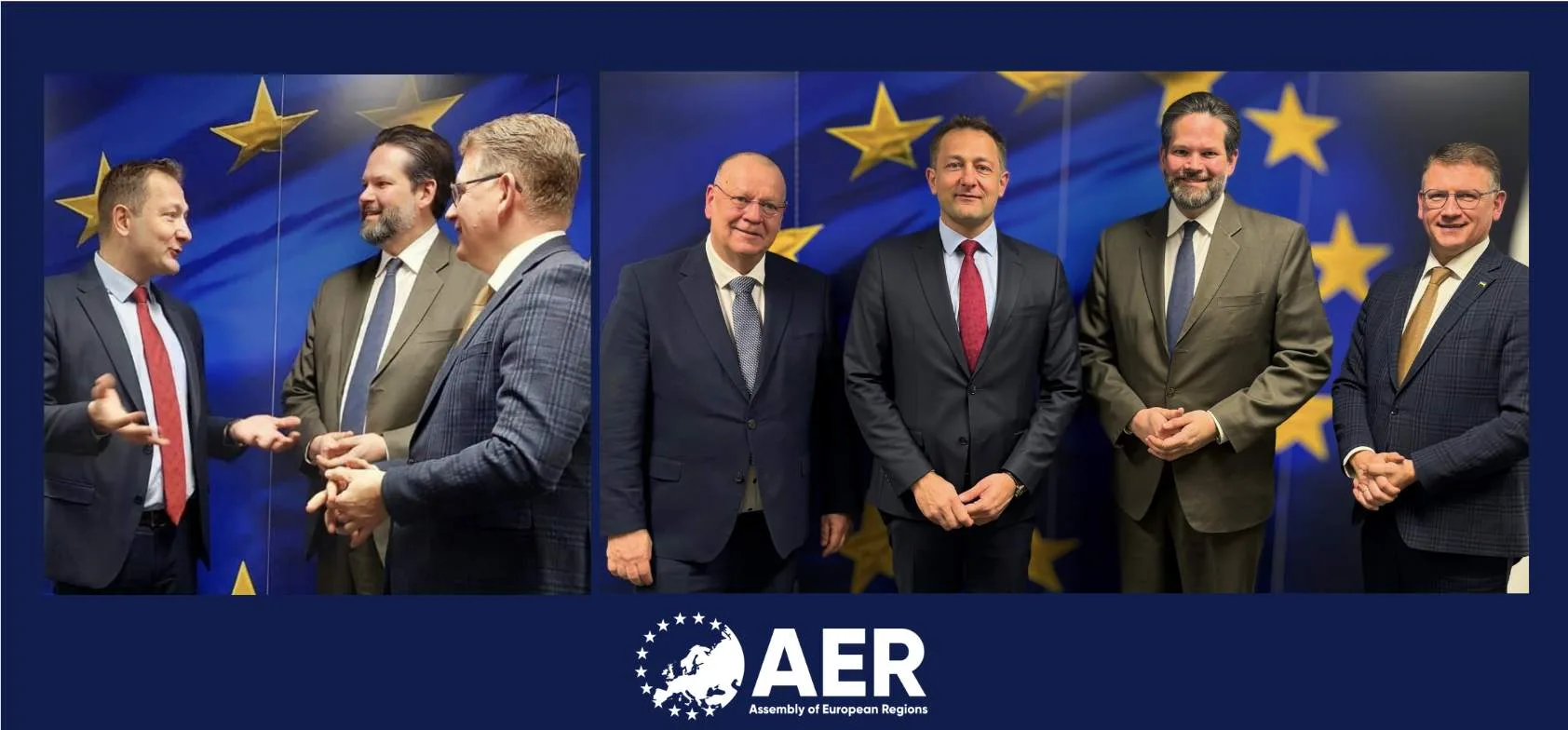


On 2 February in Brussels, the Assembly of European Regions (AER) took a strong and united message to the European Commission:
Europe’s future agricultural and rural policies must be shaped with regions, not for them.
AER President Lukas Mandl, Vice President for Agriculture Harold Zoet, and Jan Klopman, Bureau rapporteur on the MFF, met with European Commissioner for Agriculture & Food, Christophe Hansen to discuss the future of the Common Agricultural Policy (CAP) and the next EU long-term budget.
This timely exchange comes at a decisive moment for regional authorities, rural communities, and farmers across Europe.
During the meeting, AER representatives expressed strong concerns about the Commission’s proposal for the next Multiannual Financial Framework (MFF) that could move decision-making away from regions.
While simplifying EU policies is often presented as a solution, sidelining regions risks making policies less effective and more distant from the people they are meant to serve. Regions are closest to farmers, rural businesses, and communities, and excluding them would weaken public trust and create unnecessary tensions between local, regional, and national actors.
The AER representatives made it clear that regions are not just implementers of EU policies, but essential partners in shaping them. Without their full involvement, future agricultural and rural policies will struggle to respond to real needs on the ground.
The discussion also focused on what rural Europe needs most in the coming years. The AER Vice President, Harold Zoet underlined the importance of fair support for farmers, food security, strong local economies, and good living conditions in rural areas. Ensuring stable incomes for farmers remains crucial, but support must also reach the wider rural economy. Particular attention is needed to help young people enter the farming profession, as Europe’s farming population continues to age, and generational renewal becomes more urgent.
Local solutions were another key point raised by the AER. Community-led approaches, such as the LEADER programme, have proven their value in responding to local challenges and strengthening rural communities. Weakening these tools would be a step backwards; instead, they should be reinforced and properly supported. At the same time, funding dedicated to rural development must remain clearly focused on rural needs, so it is not diluted or redirected away from its original purpose.
Commissioner Hansen acknowledged that discussions on the next EU budget are still uncertain. While support for farmers’ income under the CAP is protected, funding for cohesion policy and broader regional development remains at risk. He also highlighted a new commitment to generational renewal: Member States will be required to dedicate at least 6% of their agricultural budgets to supporting young farmers. This funding can help young farmers start their businesses, support the transition to more sustainable farming practices, and provide services such as cover for illness, holidays, or parental leave. Regions will play a vital role in ensuring these measures are accessible and tailored to local realities.
Finally, the Commissioner encouraged regions to look beyond traditional agricultural funding and explore other EU programmes that could support rural areas, including funds focused on innovation and competitiveness.
A call to action for regions
This meeting reaffirmed AER’s role as a strong advocate for regions in Brussels at a decisive moment for Europe’s future. As discussions on the CAP and MFF intensify, regional authorities must stay mobilised, coordinated, and vocal.
The future of European agriculture will be decided now, and regions must be in the room, shaping the outcome.
Through its Task Force on Agriculture & Rural Development, AER will continue to advocate for:
- strong regional governance
- fair and place-based policies
- a resilient and attractive future for rural Europe