

The European Commission’s proposal for the Multiannual Financial Framework (MFF) 2028–2034, worth €1.98 trillion (1.26% EU GNI), introduces National Regional Partnership Plans (NRPPs) as the main delivery mechanism for EU funds, including the European Regional Development Fund (ERDF), Cohesion Fund (CF), Common Agricultural Policy (CAP), and other instruments. While the proposal aims to streamline procedures, reduce administrative burdens, and allow Member States more flexibility, it raises serious concerns for cohesion policy, subsidiarity, and multi-level governance. Unless amended, the proposal risks weakening the foundations of cohesion policy and undermining the Union’s commitment to reducing disparities between regions.
Key issues identified:
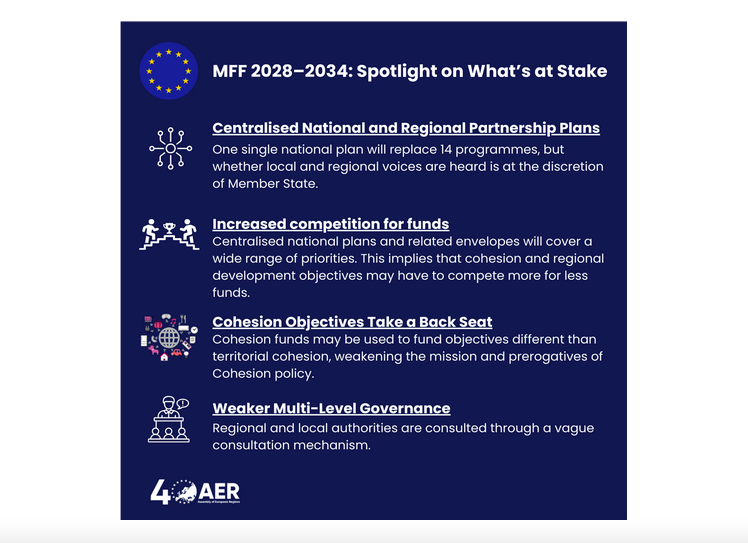
- Centralisation and simplification. Under the MFF 2028–2034, Member States will be required to prepare a single National and Regional Partnership Plan (NRPP) to replace the 14 separate programmes currently in place. While this is presented as simplification and is meant to reduce administrative burden, the reality is that the inclusion of regional and territorial chapters is left entirely to the discretion of Member States. This approach risks excluding regions from shaping priorities and undermines the territorial dimension of cohesion policy.
- Competition for funds. By expanding the NRPPs to cover a broad range of priorities —from cohesion and rural development to fisheries, migration, tourism, and even security— programmes will be forced to compete against each other within a single national envelope. This could result in a smaller share of funding being dedicated to genuine cohesion and regional development objectives, particularly in disadvantaged territories.
- Dilution of cohesion objectives. The proposal explicitly opens the door to using cohesion funds to finance new policy areas such as defence and security, alongside traditional objectives. Grouping such diverse priorities under one plan risks blurring the focus of cohesion, creating divergence between goals, and undermining efforts to reduce inequalities. Flexibility may be useful, but not if it comes at the expense of cohesion’s core mission.
- Weak Multi-level governance. The NRPPs include only a vague mechanism for stakeholder consultation, which places regional authorities on the same level as other secondary actors such as academia or civil society organisations. This diminishes their role in shaping investment priorities and reduces multi-level governance and bottom-up approaches to little more than theoretical principles rather than applied practices.
Too much flexibility diverts resources from territorial needs. Member States are granted significant leeway to amend their NRPPs in response to crises or unforeseen circumstances. However, there is no obligation to consult regions when making these adjustments, creating a real risk that territorial priorities will be ignored or sidelined when decisions are taken.
The proposed MFF 2028–2034 seeks to streamline procedures, reduce administrative burdens, and provide flexibility in times of crisis. Yet behind these intentions lies a worrying trend towards centralisation, dilution of cohesion policy objectives, and marginalisation of regions. By merging multiple funds into a single plan per Member State, concentrating decision-making power in national governments, and weakening the principles of multi-level governance and subsidiarity, the proposal risks undermining the very purpose of EU cohesion policy: to reduce disparities, empower regions, and ensure no territory is left behind.
Cohesion cannot be achieved through one-size-fits-all solutions, nor by treating regions as secondary stakeholders. It requires genuine partnership, territorial sensitivity, and financial solidarity. Without mandatory regional involvement, stronger guarantees for subsidiarity, and a clear focus on disadvantaged areas, cohesion policy, instead of being a vibrant instrument of European solidarity, risks becoming a mere label.
The Assembly of European Regions calls on the European Commission to correct this course: empower its regions, protect cohesion funds from being diverted to unrelated priorities, and reaffirm that the future of Europe’s unity and prosperity lies in balanced territorial development, not centralised control.
To meet the European Union’s established objectives, the next MFF must be territory-driven. The AER, as a founding member of the #CohesionAlliance calls for a rebalanced financial framework that delivers real impact through simplification, subsidiarity, and cohesion-centred investments without centralisation tendencies.