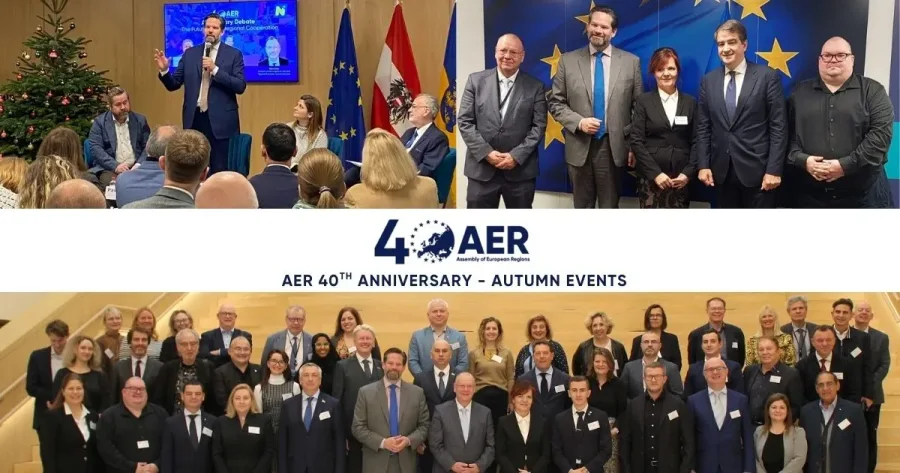


The nexus between the right to stay, territorial development and Cohesion Policy was at the core of AER Autumn Events 2025. On 9 and 10 December, regional representatives from across Europe met in Brussels to address key challenges, from the ongoing negotiations on the Multi-Annual Financial Framework to ensuring accessible and effective public services at a regional level.
The Autumn Bureau meeting on 10 December marked a pivotal moment in aligning AER members around these priorities with substantive debates on the future of Cohesion Policy in the next Multi-Annual Financial Framework, and the strategic importance of high-quality public services not only for improving citizens’ daily lives, but also for unlocking the potential of all territories, strengthening Europe’s competitiveness, and safeguarding democratic resilience.
A High-Level Dialogue on the MFF: Bridging Regions and the European Parliament
On 10 December, the AER Autumn Bureau meeting hosted a high-level debate bridging the perspectives of regional governments and the European Parliament on the future of Cohesion Policy within the next MFF. Bureau members engaged with MEPs Carla Tavares (S&D/PT), Siegfried Mureșan (EPP/RO) and Vladimir Prebilič (Greens/SI). Carla Tavares underlined that Cohesion Policy must remain a standalone EU instrument with funding at least maintained in real terms, and that regions and cities must be central to designing and delivering programmes. Siegfried Mureșan stressed that cohesion funding must not be merged with other policies, rejected any dilution of regional competences, and insisted that allocations continue to flow directly to regional and local authorities rather than being absorbed into national plans. Vladimir Prebilič highlighted the need to preserve the long-term, place-based mission of Cohesion Policy, called for simpler and more accessible rules for regions, and emphasised safeguarding the policy’s structural investment role for territories facing demographic or economic challenges. Together, they reinforced the message that Europe’s cohesion depends on empowering its regions.
This strong, cross-party message was reflected in the adoption of an amended version of the Position Paper on Cohesion Policy, which was presented by the AER Vice President for Cohesion, Lilijana Madjar, and Jan Klopman, AER Bureau rapporteur on the MFF Negotiations.
No Services, No Stay: Turning Access into a Right
The AER Autumn Bureau meeting also represented the ideal political space for the kick-off of the work of the new Task Force on Access to Services. The Bureau debate ‘No Services, No Stay’ explored how the delivery of essential services boosts the economic growth of a territory and enables the “right to stay” for all citizens in the place they call home.
Kadri Uustal (DG REGIO) opened the debate by outlining the European Commission’s support for regions facing demographic and service-delivery challenges, emphasising initiatives that strengthen community well-being and territorial cohesion, such as the Harnessing Talent Platform, of which the AER is a partner. Marc Bournisien de Valmont (OECD) presented evidence on service provision in rural, and remote areas, showing how better access boosts regional attractiveness and competitiveness.
Under the theme “No Services, No Stay,” regional representatives shared concrete challenges:
- Gerry Murray (Mayo, Ireland) on access to housing;
- Daniel Schützer (Värmland, Sweden) on healthcare gaps;
- Toni Štimac (Primorje-Gorski Kotar, Croatia) on culture and sport.
Each highlighted local impacts and proposed clear institutional actions to improve access to essential services in their regions.
In closing, Daniel Schützer invited members to join the Task Force and outlined the next steps.
The debate reinforced a shared message: ensuring access to quality services is key to territorial cohesion and to making the right to stay a reality for all regions.
Strengthening Political Dialogue with EU Institutions
The Autumn Events also provided an opportunity to reinforce AER’s political outreach at the highest institutional level. AER President Lukas Mandl and the Vice Presidents held bilateral meetings with Raffaele Fitto, European Commission Executive Vice-President for Cohesion and Reforms, and with the President of the European Committee of the Regions, Kata Tüttő.
These exchanges offered a timely occasion to convey AER members’ priorities on Cohesion Policy and the next Multi-Annual Financial Framework. Both meetings reaffirmed the importance of close cooperation between EU institutions and regional authorities, ensuring that regional perspectives are reflected in key European policy debates.
Holding Society Together through Mental Health and Intercultural Inclusion
The final meeting of the Working Group on Mental Health, hosted at the Region Värmland European Office and chaired by Daniel Schützer, explored the invisible weight of poor mental health and the crucial role that regions can play in alleviating its impact. The discussion was enriched by contributions from Norbert Nagy, President of the Youth Regional Network (YRN), and Michele Calabrò, Executive Director of EUREGHA – the European Regional and Local Health Authorities network. The meeting was an opportunity to reflect on two years of work, key milestones and the way ahead.
The day continued with the first plenary session of the Intercultural Regions Network (IRN), reaffirming its commitment to equal opportunities, diversity, and inclusion. During the session, members defined the network’s guiding principles and discussed next year’s work plan, which will focus on combating disinformation and countering negative migration narratives in collaboration with the EU Urban Partnership for the Inclusion of Migrants and Refugees, to which the AER is a partner. Angelique Petrits from DG HOME, coordinator of the Urban Partnership, outlined how she envisions the IRN contributing to the Partnership’s activities in the coming year.
AER Governance Dialogue—taking stock and looking forward
Led by Thomas Hartman, Chair of the Monitoring and Evaluation Group, there was a lively discussion on how to shape AER for the next years. Members shared perspectives on what makes AER valuable for their work, and how the network can continue to be a vital and valued platform for interregional cooperation in the future. We invite members to complete the governance survey before 31 December HERE so we can keep gathering your ideas!
Ukraine Focus Group—introductory meeting and setting out priorities
Closing the Autumn events, Vice President and Ukraine Focus Group Chair, Christian Debève convened the Ukraine Focus Group at the EU office of Grand Est region. Vice President Tetiana Yehorova-Lutsenko and Bureau member Roman Saray set out the situation in Kharkiv and Transcarpathia, respectively. Mr Saray presented the Carpathian Integration Initiative as a best practice to strengthen regional cooperation. Members were also briefed on the TIPS4UKRAINE initiative, which provides Ukrainian politicians and civil servants with traineeship opportunities on EU project management in cooperation with EU/EEA regions and municipalities. It is foreseen that AER will take a leading role in developing this programme in 2026.
Get ready for the AER General Assembly in Timișoara, 2-4 June 2026!


