

How can regions across Europe effectively support the inclusion of migrants and refugees, while taking into account local diversity, needs, and capacities? This is the challenge the EU-Belong project set out to address. The outcome is an innovative and adaptable model that supports regions in embedding intercultural principles into local governance, helping to build stronger and more cohesive societies.
Tested in ten regions across seven European countries, the EU-Belong Model provides a practical approach for turning inclusion into a participatory and sustainable reality.
A Model Built on four Pillars
The EU-Belong Model is structured around four interconnected pillars that can be applied in diverse regional contexts.
- Assessment of Regional Integration Contexts
- Development of a Multi-Stakeholder Framework
- Co-Design of Context-Sensitive Solutions
- Testing Through Local Pilot Projects
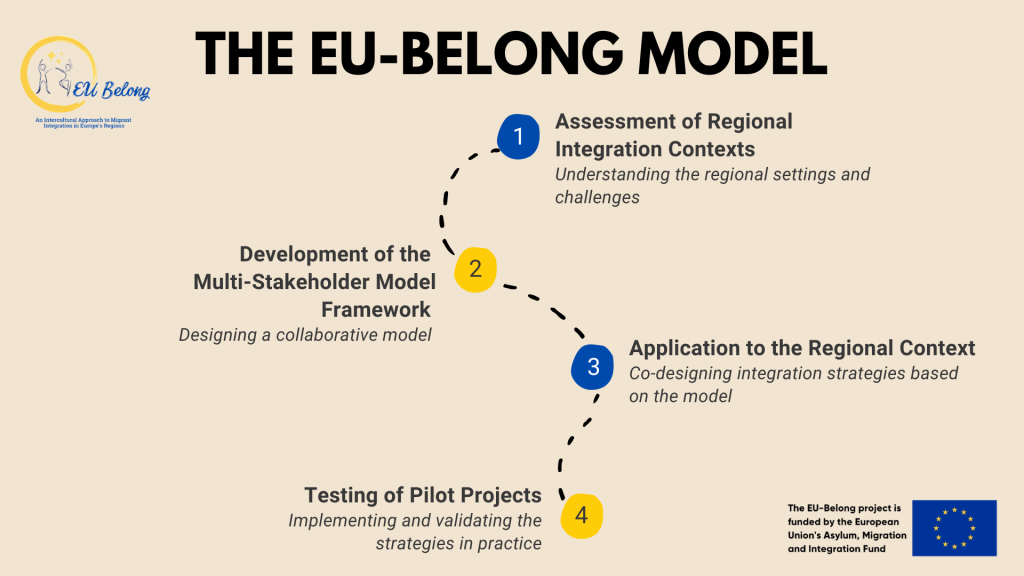
These pillars form the foundation of a process that is both strategic and flexible, offering regions the tools to tailor their inclusion work to local realities.
Pillar 1: Assessment of Regional Integration Contexts
The first step in the EU-Belong Model involved a structured self-assessment by each region. This process enabled regional actors to explore their specific integration landscapes and identify key priorities. By taking stock of existing policies, demographic trends, social dynamics, and institutional structures, regions could define what inclusion meant in their own context.
This assessment also involved mapping key stakeholders across sectors, from public authorities and civil society organisations to academic institutions and private actors, in order to create a solid base for inclusive collaboration.


Pillar 2: Development of a Multi-Stakeholder Framework
Once the regional context was assessed, the next step was to develop a multi-stakeholder framework. Regions were supported in creating structures for cooperation that included a wide range of actors. These frameworks aimed to bring together institutions, communities, and individuals in a shared effort to promote inclusion.
This pillar focused on building strong foundations for governance: ensuring that all relevant voices were heard, and that decision-making was transparent, participatory, and inclusive.
Pillar 3: Co-Design of Context-Sensitive Solutions
Each region organised participatory consultations and co-design meetings to identify key challenges and opportunities. The resulting strategies included concrete actions, clear responsibilities, dedicated resources, timelines, and indicators for monitoring progress. Although their thematic focus varied, all strategies were guided by shared values: equality, diversity, participation, and meaningful interaction.
Building on the first two pillars, the third pillar of the EU-Belong Model was the co-design of regional intercultural strategies. This process brought together local stakeholders, including migrants and refugees, to shape strategies based on real needs and experiences.
Pillar 4: Testing Through Local Pilot Projects
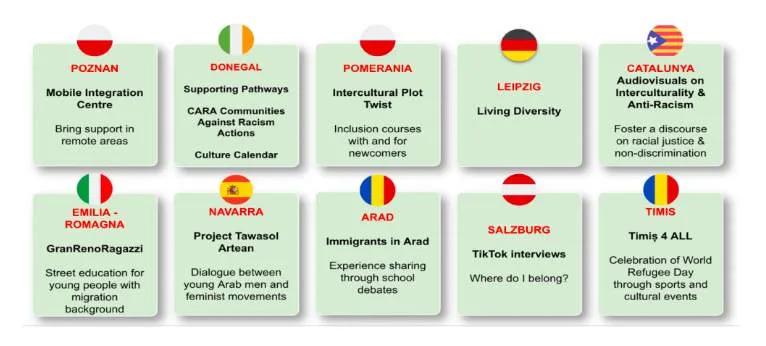
The final pillar involved turning strategy into action through pilot projects. These were not stand-alone experiments, but carefully designed actions aligned with each region’s broader inclusion strategy.
The pilots served as testing grounds for locally responsive, innovative practices. They allowed regions to experiment, adapt, and learn in real time, helping to define what effective pilot action looks like in the field of regional inclusion. In doing so, they demonstrated the value of responsiveness, flexibility, and practical learning.
Why the EU-Belong Model Matters
The EU-Belong Model arrives at a critical time, as European societies continue to look for effective and inclusive ways to support integration and social cohesion. One of the project’s key lessons is that regional authorities are not just implementers of national or EU policies, they are co-creators of long-term, inclusive change.
By combining strategy with action, and local knowledge with shared European values, the EU-Belong Model offers a replicable approach for regions across Europe. Whether your region is just starting out or seeking to strengthen existing work, this model provides the tools, methods, and inspiration to take the next step.
Want to learn more?
Explore the full report on the EU-Belong Model, as well as the other publications on the project website.


About EU-Belong
EU-Belong is a 3-year project co-funded by the Asylum, Migration and Integration Fund of the European Union. Coordinated by the Assembly of European Regions (AER) within the framework of its Intercultural Regions Network (IRN), it is implemented in partnership with ten regional authorities from seven European countries: Arad and Timiș in Romania; Catalonia and Navarra in Spain; Donegal in Ireland; Emilia-Romagna in Italy; Leipzig in Germany; Pomerania and Wielkopolska in Poland; Salzburg in Austria; and two technical partners: Attrattività Ricerca Territorio (ART-ER, Italy) and Istituto Economico Cooperazione Internazionale (ICEI, Italy).
For questions, contact Mirjam de Jong (AER Projects Coordinator) at [email protected]


