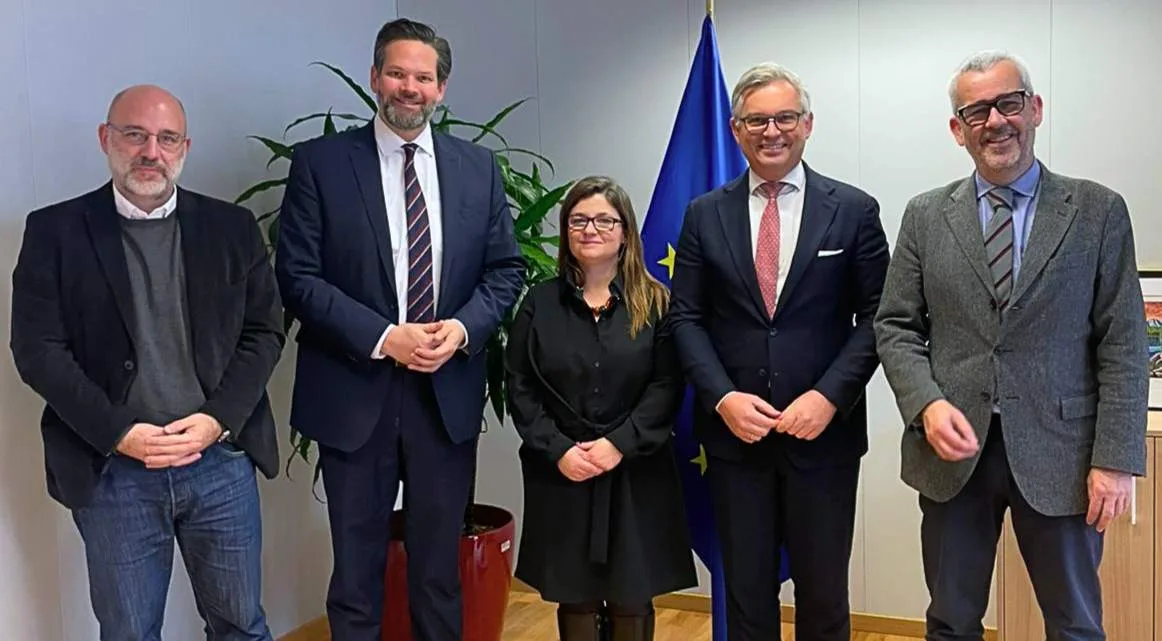


Brussels, 3 February 2026 – Representatives of the Assembly of European Regions (AER) met with Commissioner Magnus Brunner, responsible for Migration, to underline the essential role of regions in the design and implementation of EU migration and inclusion policies, particularly in the context of the upcoming Multiannual Financial Framework (MFF).
The AER delegation, composed of AER President Lukas Mandl, AER Vice President Agustí Fernández de Losada, and Chair of the Intercultural Regions Network (IRN) David Moya, used the meeting to convey regions’ key concerns directly to the Commissioner. They stressed that for the next MFF to deliver effective results on the ground, the meaningful and systematic involvement of regional authorities is indispensable.
AER representatives emphasised that regions should be recognised as valuable assets in migration and inclusion policies, rather than as secondary stakeholders. Regional authorities play a decisive role in inclusion and integration, yet their importance is not always sufficiently reflected in policy frameworks. In many Member States, regions hold clear competences in migration and inclusion, but their involvement varies significantly. While some governance systems require regional participation, others exclude regions entirely, despite their responsibilities and expertise.
To address this challenge, AER proposed the establishment of a permanent and structured mechanism to reinforce and formalise the involvement of regional authorities by Member States in migration- and inclusion-related interventions, particularly in areas where regions have relevant competences. The delegation also highlighted the need to better assess how regions are engaged in practice, especially in critical areas such as contingency planning, where regional involvement is essential.
The discussion highlighted that strong regional involvement is fundamental to improving the quality and effectiveness of responses to migration and integration challenges. Successful inclusion policies are key to making migration work in practice and are crucial for fostering social cohesion, countering political polarisation, and strengthening democratic resilience across Europe.
Commissioner Brunner acknowledged the importance of local and regional authorities as levels of governance that deal directly with the realities of migration and inclusion on the ground. While the implementation of the Pact on Migration and Asylum remains primarily the responsibility of Member States, the Commissioner confirmed that the European Commission is seeking to ensure that regions are taken into account during implementation of the Pact.
Looking ahead, Commissioner Brunner also noted that the financial envelope dedicated to migration under the next MFF is expected to increase significantly, further reinforcing the need for strong regional involvement to ensure that EU funding delivers tangible results at the local and regional level.
📌A call to action for regions
This meeting reaffirmed AER’s role as a strong advocate for regions in Brussels at a decisive moment for Europe’s migration and inclusion agenda. As discussions on the Pact on Migration and Asylum and the next MFF intensify, regional authorities must remain mobilised, coordinated, and vocal.
👉 Effective migration policies are built locally, and regions must be in the room, shaping decisions that directly affect their communities.
Through the AER Intercultural Regions Network, AER will continue to advocate for:
- the systematic involvement of regions in migration and inclusion policies
- strong, multi-level governance that reflects regional competences
- well-designed inclusion policies that strengthen social cohesion and democratic resilience