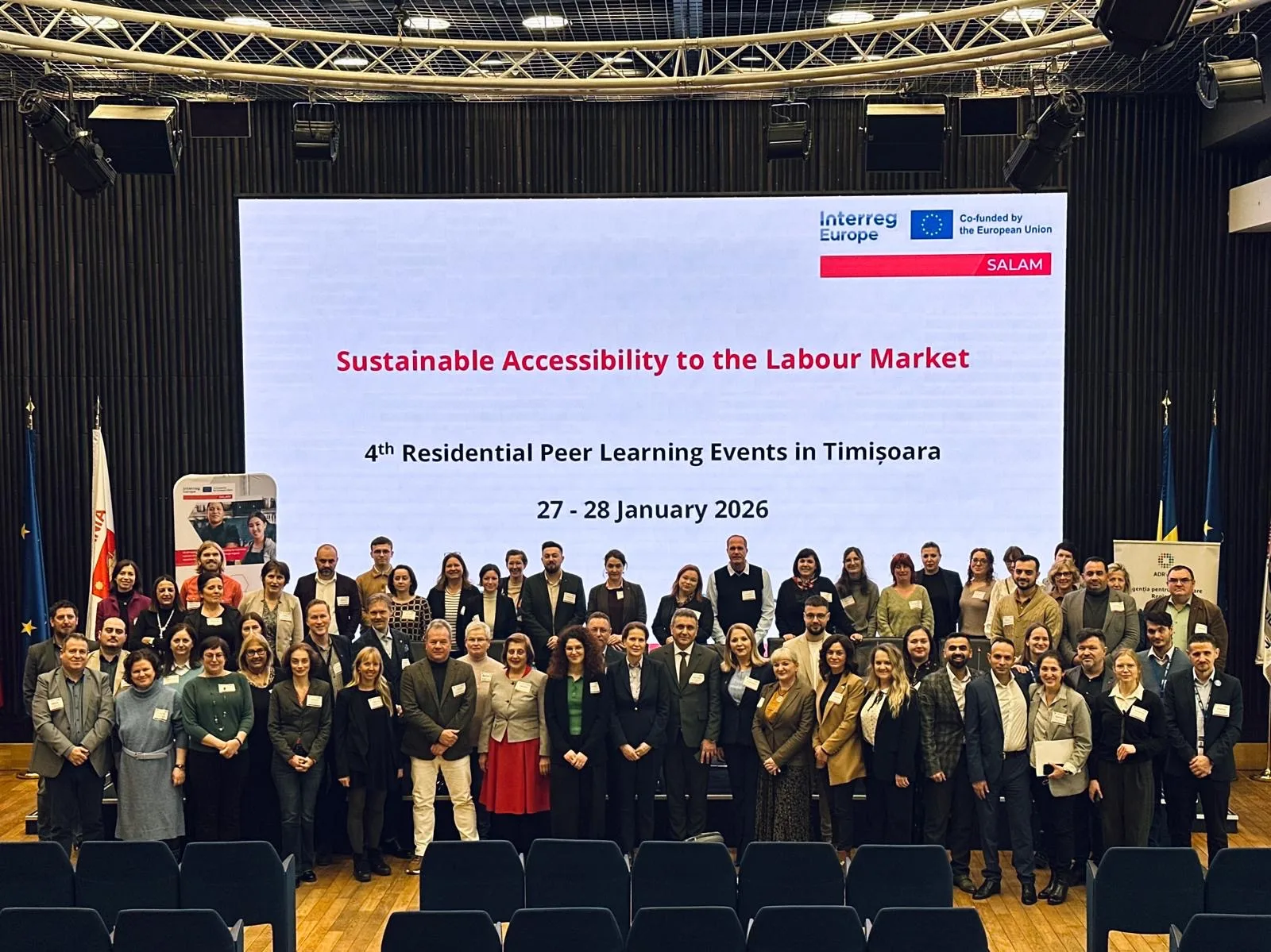


Timișoara, the regional capital of Timiș County, recently hosted the 4th Residential Peer Learning Event of the SALAM- Sustainable Access to the Labour Market (Interreg Europe) project, bringing together European partners and local stakeholders to exchange experiences and good practices on migrant integration and social inclusion
As a follow-up to the EU-BELONG project, and within the Intercultural Integration Strategy of Timiș County, adopted during the project, local stakeholders actively contributed to the discussions. The event highlighted how EU-funded projects can generate long-term impact when their results are embedded in local governance and policy frameworks. It also provided an important platform to showcase local progress and build synergies between European initiatives working toward inclusive and cohesive communities.
The meeting, hosted at the Timiș County Council, opened with a strong emphasis on migration as a global phenomenon requiring coordinated, informed institutional responses. Representatives from regional, national, academic, and European levels highlighted migration both as a challenge and an opportunity for regional development, social cohesion, and labour market sustainability.
Speakers underlined the strategic role of regional authorities in connecting stakeholders and fostering dialogue, as well as the importance of sustainable integration policies that translate migration into socio-economic value. National perspectives stressed migrants’ access to the labour market as a response to workforce shortages and referenced Romania’s engagement with the European Migration and Asylum Pact.
Academic contributions highlighted demographic decline, skills mismatches, and the need for closer cooperation between universities, public authorities, and civil society to improve integration outcomes. At the European level, the SALAM project was presented as a key framework for strengthening regional skills ecosystems and migrant inclusion through cross-regional learning and concrete policy action.
Participants were also introduced to regional and European initiatives related to talent attraction, innovation, and migration governance, alongside research findings on migration trends and public perceptions in Romania. Interactive exchanges showcased good practices in socio-cultural and professional integration, complemented by first-hand testimonies from migrants.
The programme concluded with study visits to local integration actors, including LOGS – Social Initiative Group and the Emergency Transit Centre for Migrants in Timișoara, a unique facility providing temporary protection and relocation support for refugees. The second day continued with bilateral exchanges focused on SALAM policy instruments.
During the event, the EU-BELONG Project Manager presented the main outcomes of the project, with a particular focus on Timiș County’s experience in developing and implementing its first Intercultural Integration Strategy. The presentation outlined the participatory, multi-stakeholder, multilevel approach used throughout the project, emphasising capacity building, inclusive governance, and cooperation between public authorities, civil society, academia, and migrant communities.
The Timiș experience demonstrated how structured dialogue, pilot actions, and continuous stakeholder engagement can strengthen local capacities and translate European principles into concrete, locally tailored solutions. Particular attention was given to the role of learning labs, intercultural training programmes, and pilot initiatives—such as community-based events—in fostering trust, empathy, and intercultural competences.
The SALAM Peer Learning Event also served as an opportunity to reflect on lessons learned, challenges encountered, and the transferability of good practices developed under EU-BELONG. The exchange confirmed the importance of continuity between projects and the value of capitalising on existing strategies and networks to ensure sustainability beyond project lifecycles.
By connecting EU-BELONG results with the ongoing work of the SALAM project, Timiș County reaffirmed its commitment to inclusive, participatory, and evidence-based approaches to migrant integration, while contributing actively to European dialogue and mutual learning among regions.


